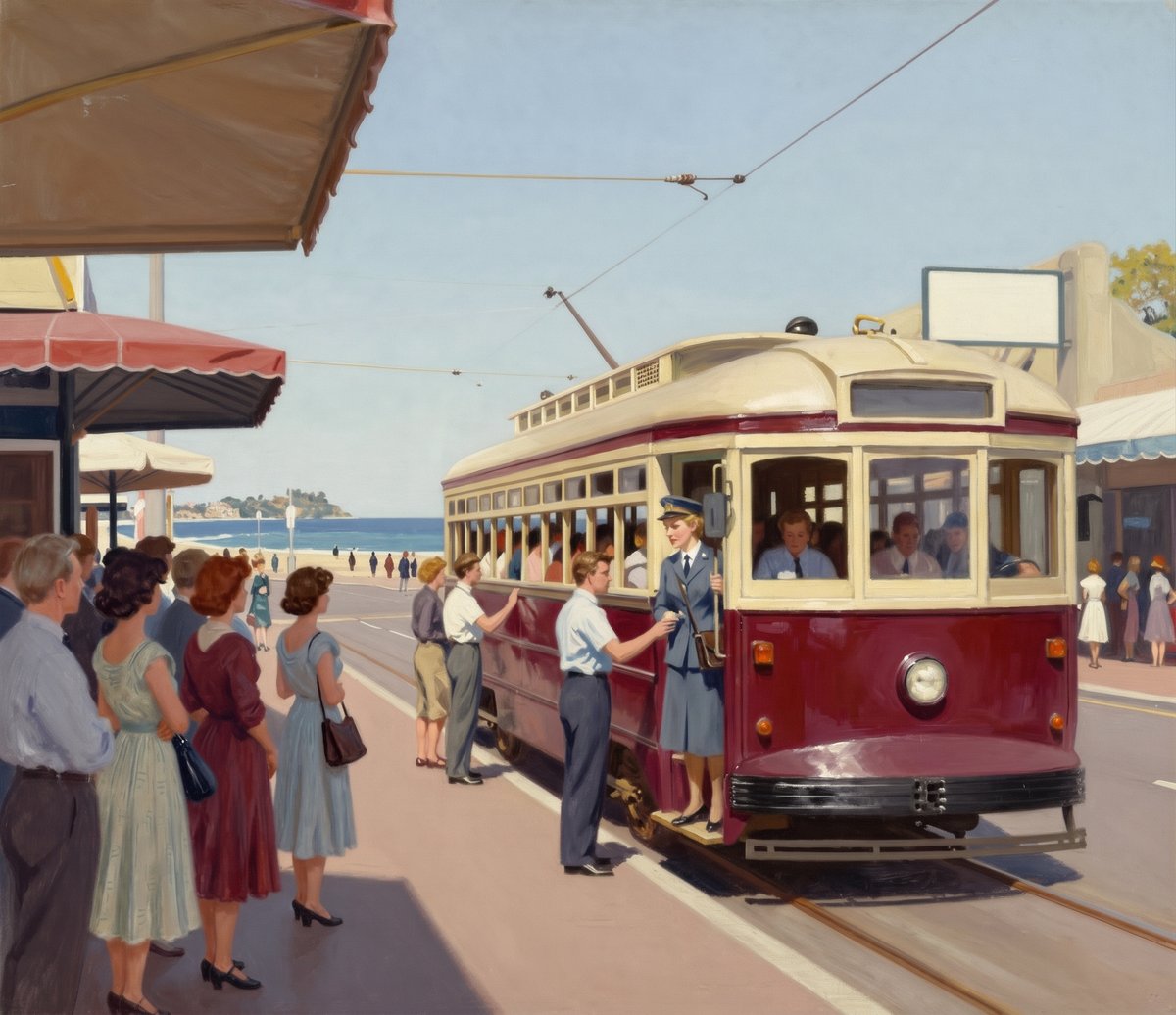
A crowded car pulling in at the beach end with the queue already forming and the conductor on the running board. In 1946 this is not nostalgia — it is simply how the whole suburb gets to work.
The patch
The line itself, and everything strung along it. In 1946 the Bondi trams are at their absolute peak — crowded, essential, permanent-seeming, the way the whole suburb gets to work and to the water — and Tess Treloar works them as a conductress, one of the women hired during the war and now quietly on a clock, because the men are coming back and the jobs were only ever lent.
From the running board she can see the entire district and most of what is wrong with it. The patch runs from the Waverley depot down Campbell Parade to the beach, with her mother's tea rooms as the unofficial office and a flat above a shop where a shoebox of letters keeps getting fuller.
The set
- The Kingfisher Tea Rooms — her mother's place off Campbell Parade — marble tables, scones under a dome, the tea urn going. Gossip concentrate, and the practice's unofficial office.
- The Waverley depot — rosters, waybills, inspection pits and a noticeboard; the depot girls' world, and the face of the clock that is counting them out.
- The flat above the shop — one shared room, a dog basket by the door, and a shoebox on the table filling up with other people's troubles.
- The beach between the flags — no club, no board, no ambitions — just the water she gets into to stop counting for a while.
- Paddy's Market, before dawn — crates and barrows and the other 1946, an hour's tram ride and a world away from the beach.
- The children's welfare house — kind, rulebound and doing hard work on far too little money. In these books the wrong is always done TO it, never by it.
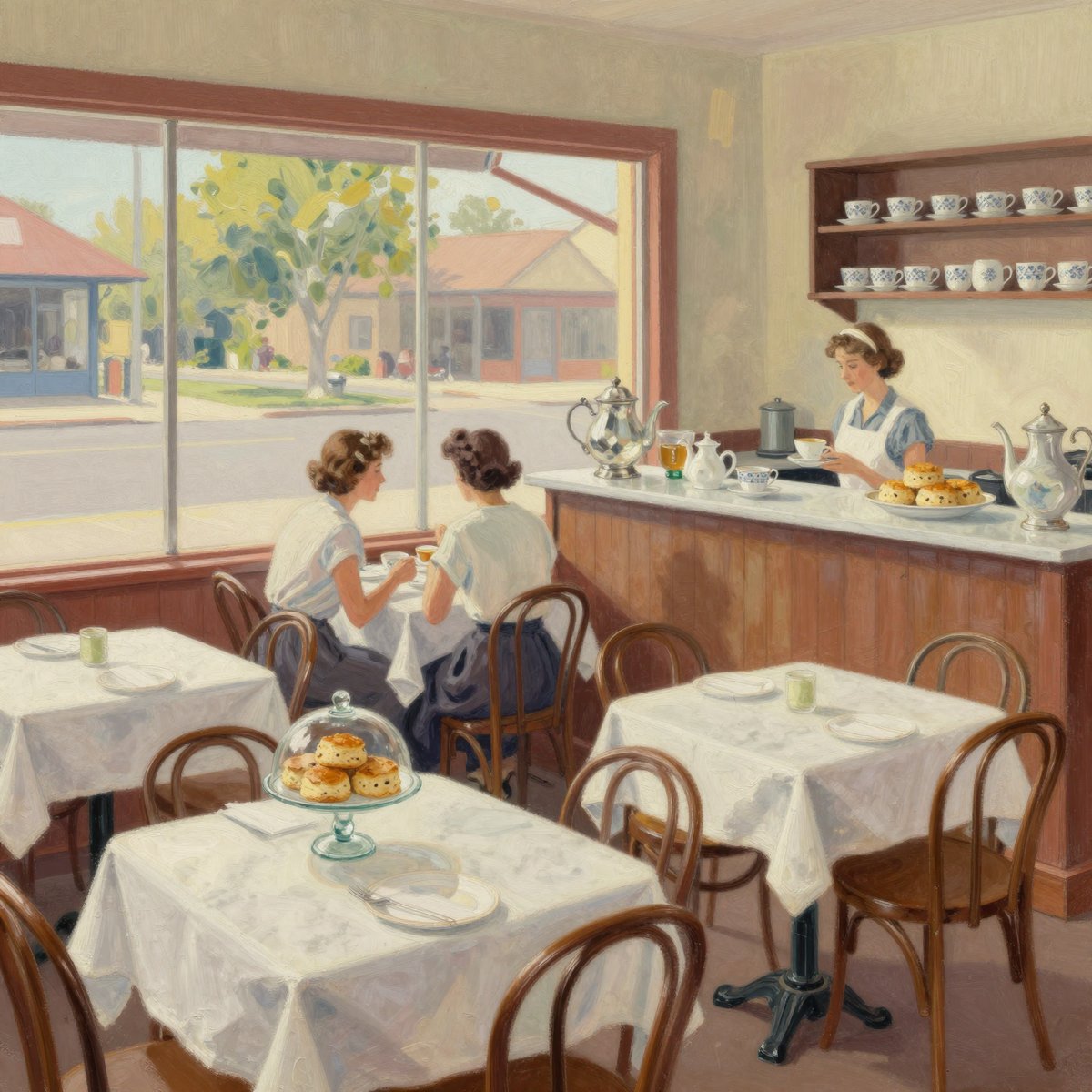
Marble tables, starched cloths, scones under the dome and the urn going. Officially a tea room; in practice the place where the district tells on itself.
The cast
Told in one voice, Tess's. In brief:
- Tess Treloar — about twenty, slim and on the tall side, fair-gold hair pinned up under the cap. A wartime-hire conductress who knows half the district by which stop they get off at, counts under her breath when she is worried, and reduces most things to "fair's fair".
- Olive Treloar — her mother — a first-war widow who runs the Kingfisher, and whose tea shop is scar tissue made of scones and starch. Friction first, then a partnership of equals.
- Carmela Vitale — an Italian war refugee and dressmaker who arrives as one of the letters and stays as the other half of the operation. She reads class off cloth and can dress anyone to be underestimated.
- Len Furlong — demobbed ex-conductor who wants his old job back, and the job in the way is hers. That is the whole problem, and neither of them pretends otherwise.
- Zac — the dog in the basket by the door, and the reason the flat feels like somewhere to come back to.
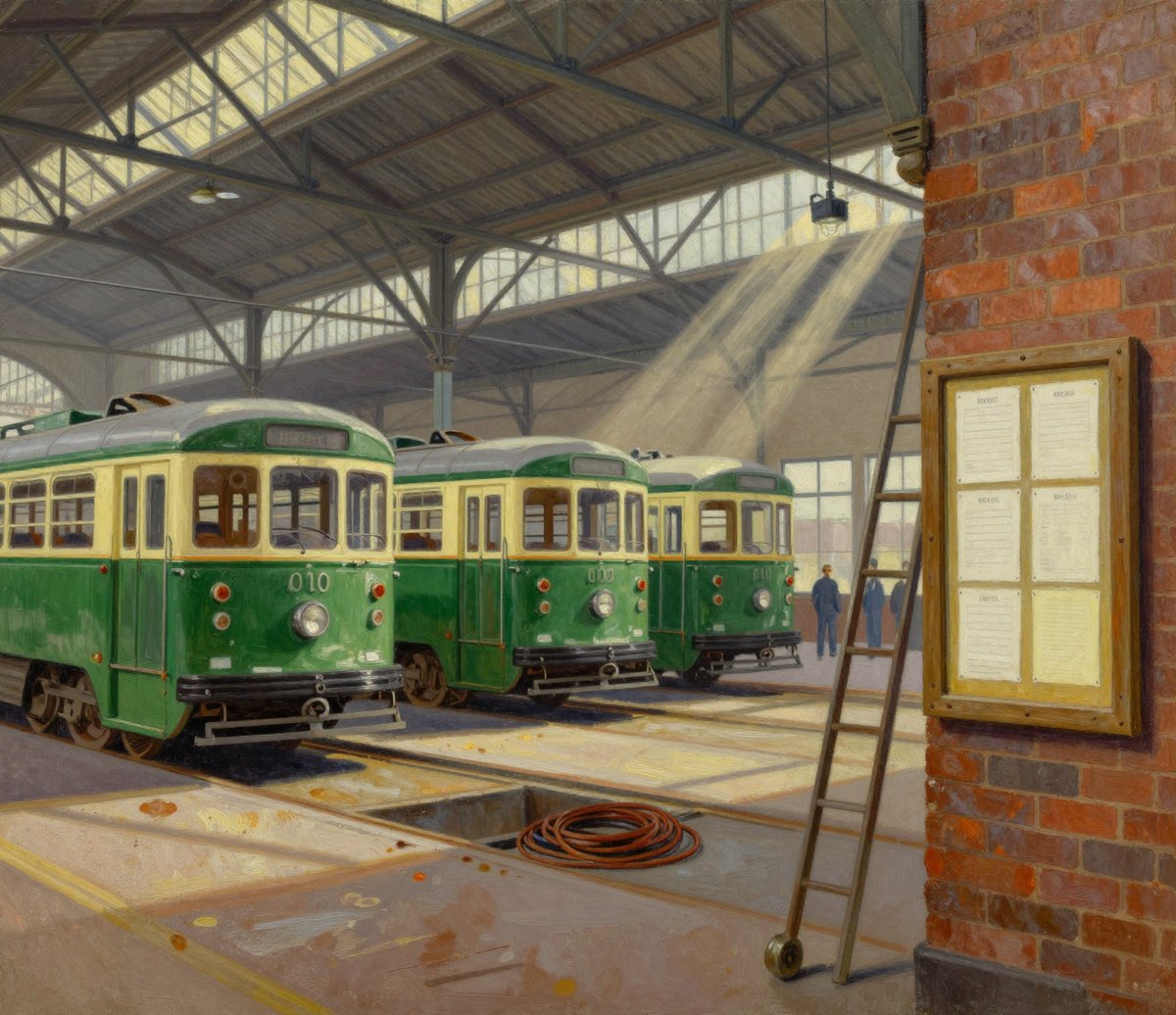
Three cars in over the pits, shafts of light through the clerestory, and a noticeboard by the door where the rosters go up. The depot is where the clock on her job is kept.
The rhythm
Eight non-murder "how-done-it" cases. Nobody dies; what happens instead is that somebody is cheated — a frame-up, stolen wages, a key-money racket, a pension that was never filed — and the mechanism is the puzzle. Tess has no shingle, charges nothing and does not consider herself a detective; the work keeps happening to her because she answers her mail.
Under it runs the retrenchment clock: the conductresses are being counted out, and she knows it from book one. Warm, funny, specific about money and paperwork, and unsentimental about who the era protects.
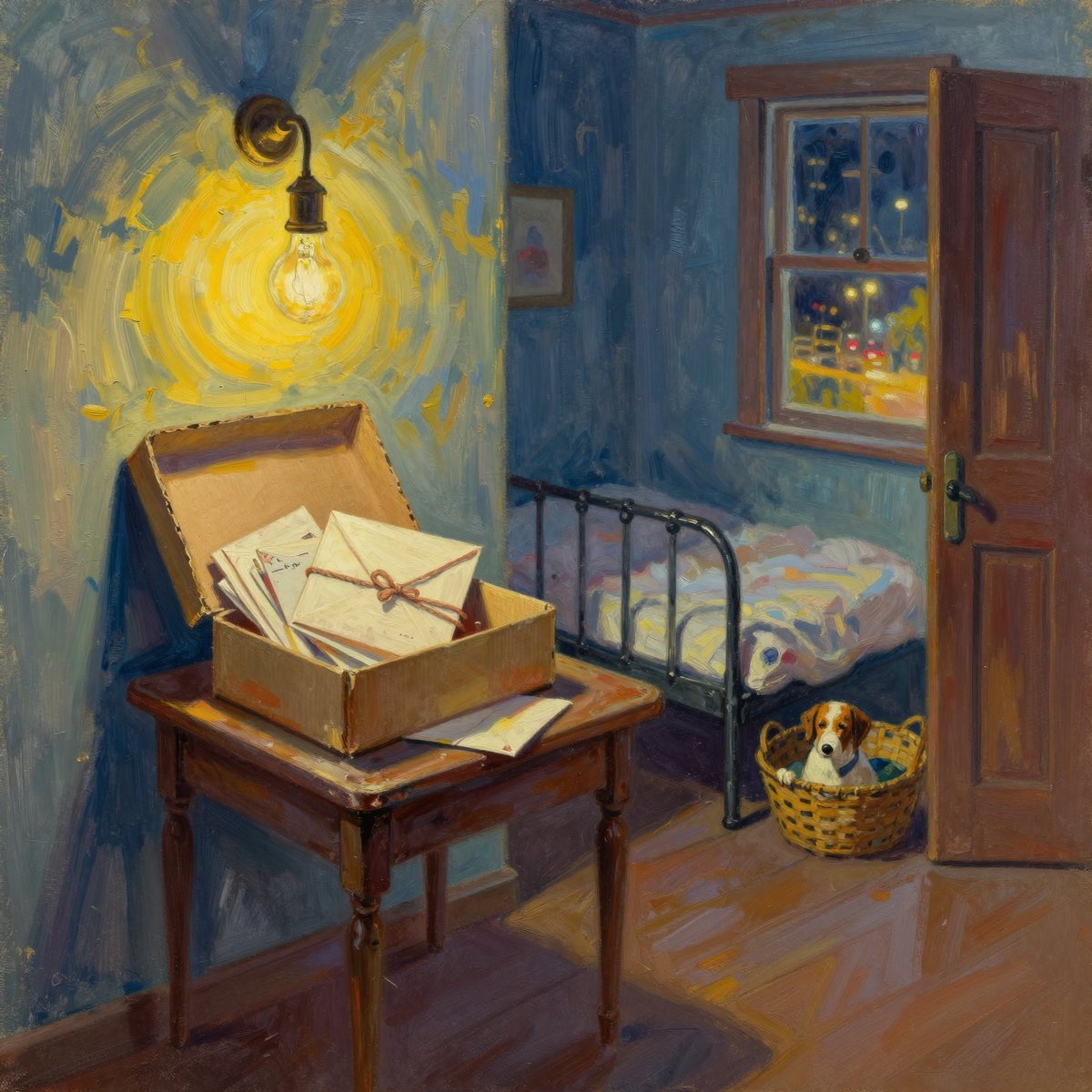
The shoebox on the table under a bare bulb, and the dog in his basket by the door. She never advertised for any of this. She just answered the wrong post.
The question the series asks
What do you owe someone whose trouble is nobody's job to fix?
Where to start
Each case is complete in itself, but the retrenchment clock runs across all eight and Tess's own position changes with it, so the order matters.
- The Crooked Waybill — start here. Damage and fare shortfalls pinned on her by a depot clerk who is not being malicious, just loyal to the wrong person. She clears herself, places a newspaper ad, and gets the wrong replies.
- The Gift Gone Sour
- The Landlord Who Wasn’t
- The Beach Gear Affair
- The Widow in the Drawer
- The Missing Fiancé
- The Man Her Son Sent
- The Last Run — the last one, and the title means what you think it means.