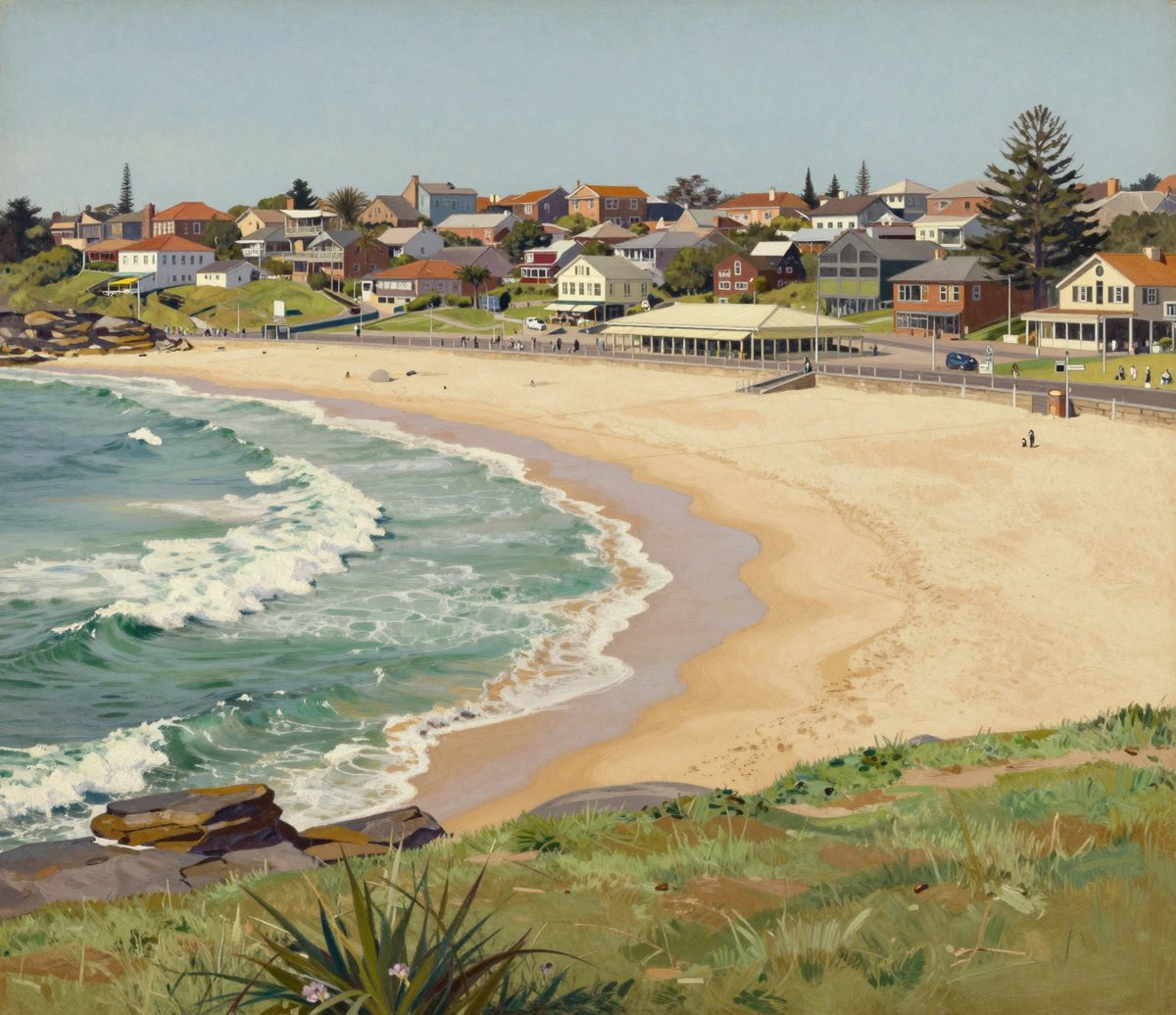
One square mile seen from the headland: surf working the south end, the pavilion along the promenade, and the houses stacked up the hill behind it. Everything in these books happens between the water and that skyline.
Standing line
Bondi Beach, Sydney, in the second half of the nineteen-forties — one square mile of sand, trams and salt, and the people putting themselves back together on it.
The place, physically
A mile of sand facing east, and a suburb built along the top of it. Campbell Parade runs north with the sea on its right shoulder and shopfronts on the left, awnings out over the footpath like a row of hat brims: the chemist, the greengrocer, the milk bar, the fish shop breathing vinegar and hot fat onto the street. Behind the Parade the streets climb — weatherboard cottages, brick flats, back gates, verandahs with cane chairs and the sea audible over the rooftops. Trams come down Bondi Road and grind away toward the terminus, and on a southerly night the wires sing overhead. Below the road: the Pavilion, the promenade, and the baths cut into the rock at the southern end where the water is green and cold all year. Before seven the beach belongs to the swimmers, the dog-walkers and the gulls. The salt gets into everything here and stays — door latches, brass, the grain of a surfboard left too long on its rack.
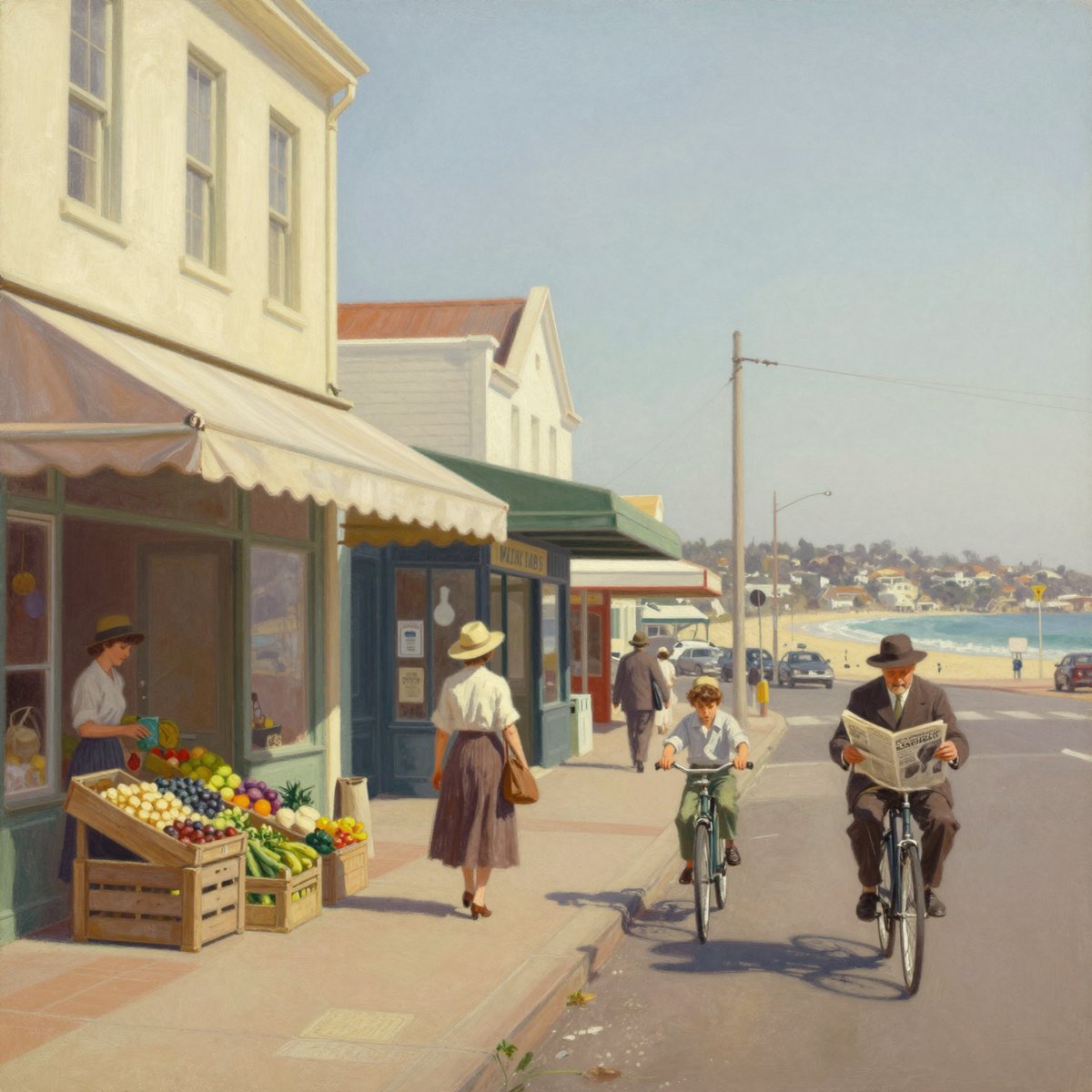
Campbell Parade, mid-morning. Awnings out, string bags, and a street where being seen is most of the information system.
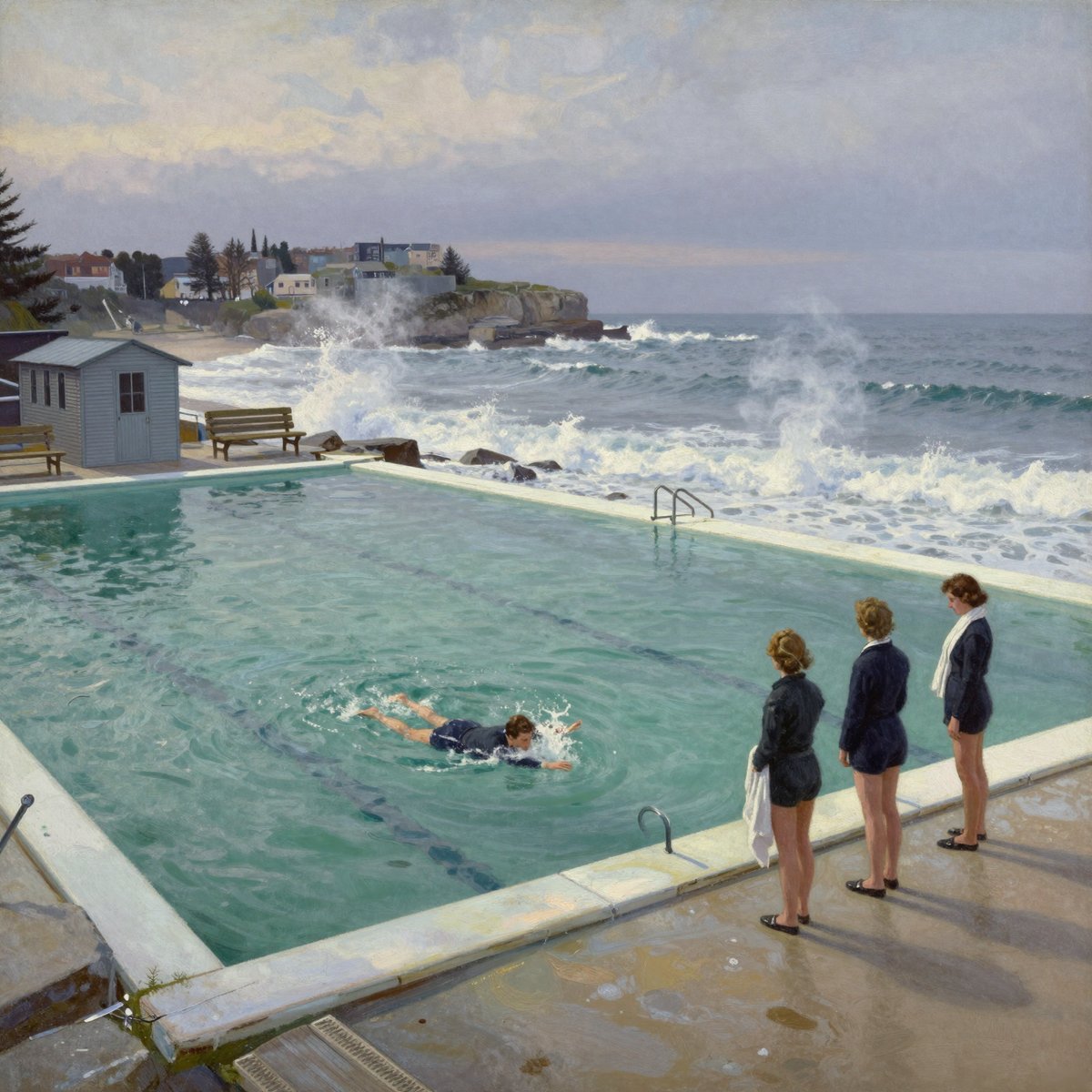
The baths at the southern end, swum all winter. The regulars call it the cold water, and they do not explain further.
The time
The mid to late nineteen-forties. Most of these books sit between 1946 and 1949, when the war has been over a year or three and has not finished happening. Men come home on the tram from Central with kit bags on their knees; telegrams that arrived in '42 and '43 are still standing on mantelpieces. Rationing has not gone — butter, tea, meat, and clothing still on coupons. Money is pounds, shillings and pence, houses are short, and rents are rigged. The women who drove the trams and wrote the newspaper while the men were away are being handed their notice, one Thursday at a time. And the ships have begun to arrive with people who will be told, kindly, that they are New Australians. A few of these books reach back into the war itself; one line runs on a little past the rest.
Almost all of these books sit between 1945 and 1950, and most open in 1946 or later. Only one series is wholly wartime — Dot's classroom. Nothing here runs past 1950.
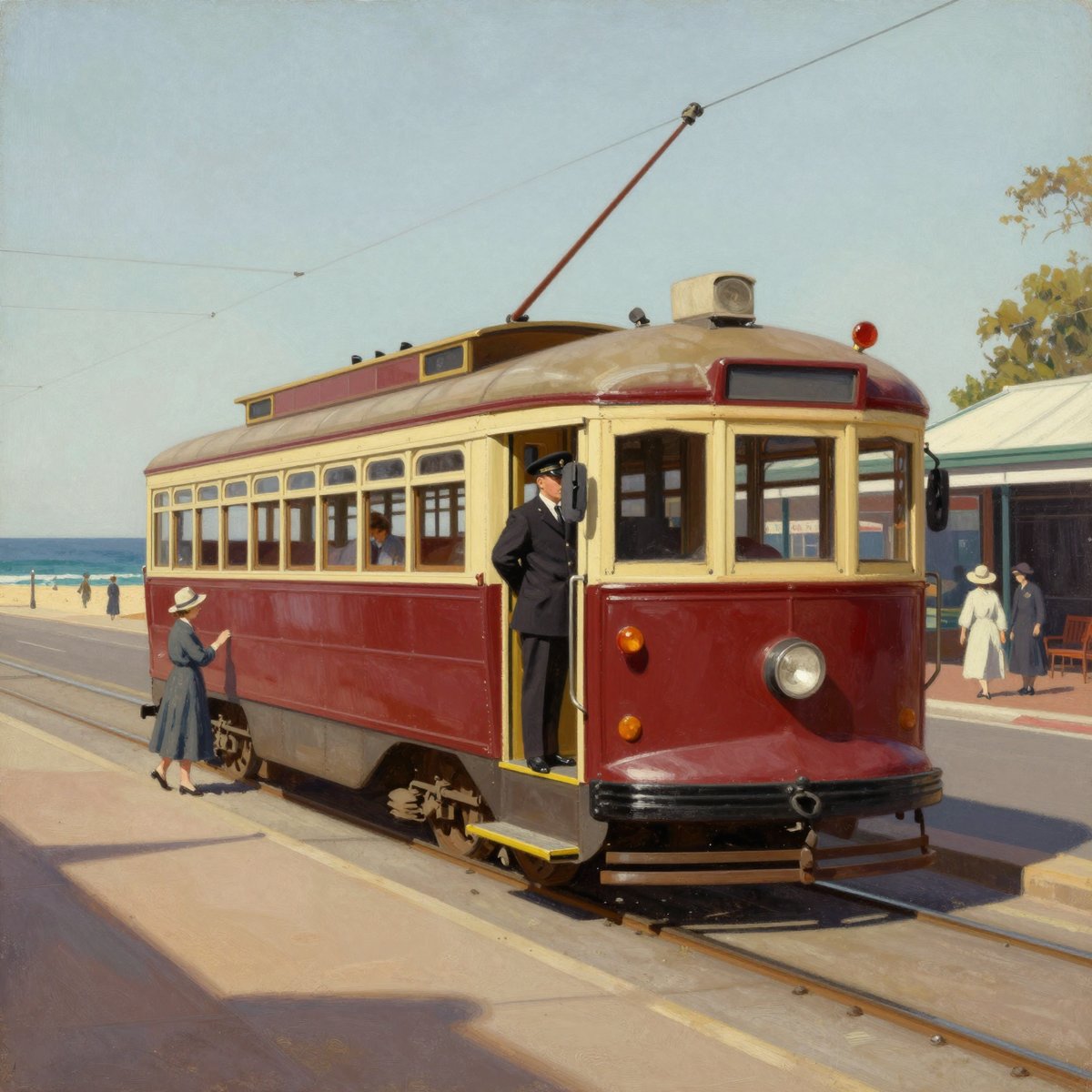
The tram at the beachfront stop. It is how everyone arrives and leaves, and a conductor who knows the stops knows how long a man has been telling the truth.
Daily life
Milk comes to the back step in two bottles, with a note if the horse is off his feed. The copper goes on early; the ice chest wants another block by Saturday. Breakfast is toast and the wireless turned up for the news, and by evening that same wireless is running a Bing Crosby number and the six o'clock racing results together into one cheerful argument nobody troubles to settle. Men swim at the baths before light. Children are sent to the shops with the money counted into their hands. The pubs shut at six and empty onto the footpath. Friday is fish, wrapped in yesterday's newspaper. Thursday might be the Guild hall — trestle tables, an urn, and every district secret passing through a new organisation still finding its feet. Saturday is the beach, the carnival, the flower show; the tram out and the tram back, and sand still in your shoes on the step.

The room most of these books actually turn in. Not the crime scene: the kitchen afterwards, with the kettle going.
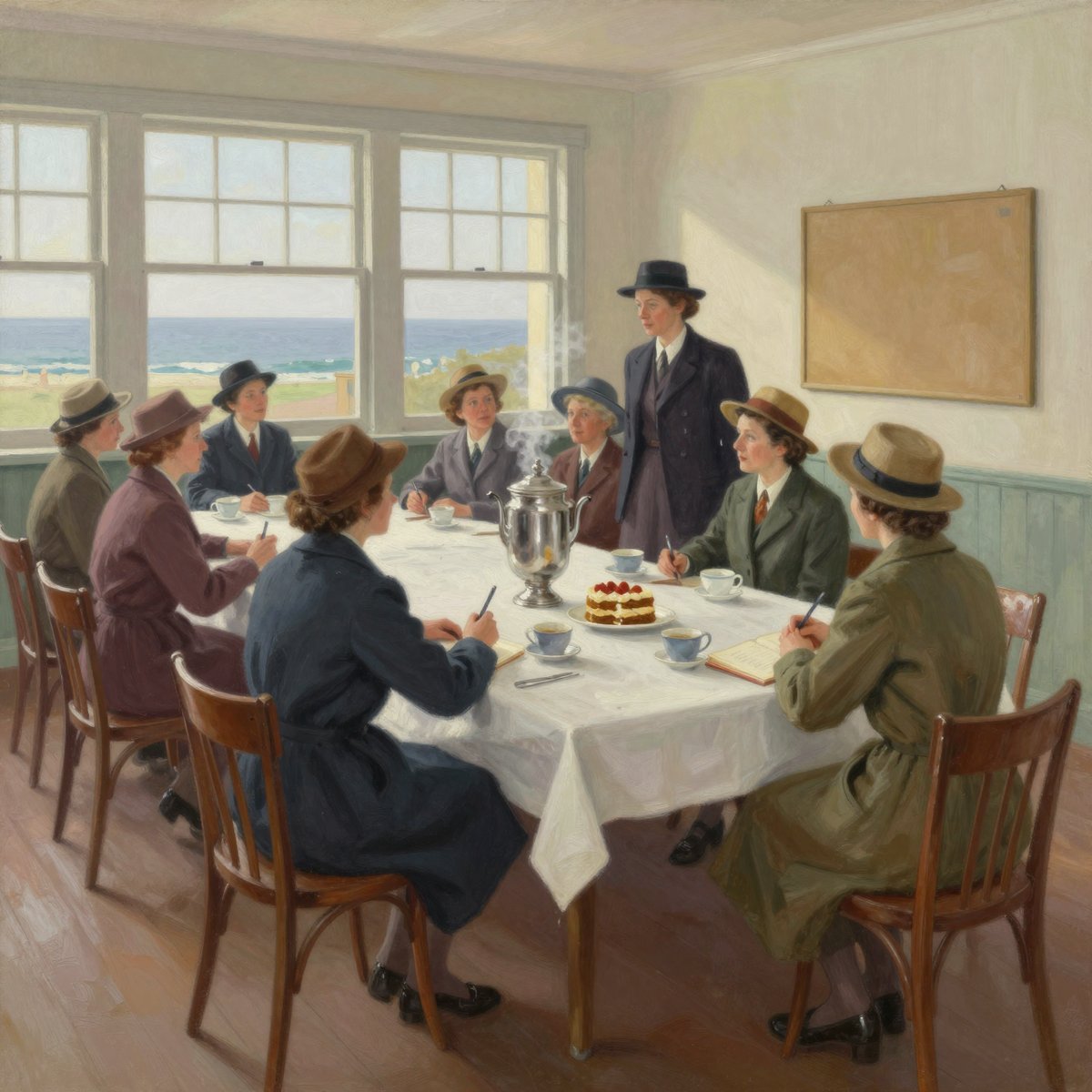
Thursday at the Guild. An urn, a minute-book, and more of the district's business settled here than at the police station.
The rules
Everyone knows everyone's business, and that is both the danger and the safety. A woman teacher gives up the job when she marries. A war widow gives up rather more, and the pension wants a form and a witness, and often enough the only witness was the sea. Work a woman did for six years belongs, now, to the man who has come back for it — nobody says so straight out; they simply stop handing her the work. A shopkeeper with the wrong surname learns which fault lines a neighbour can be talked into. Against all of that: the woman who takes in the washing, the counter where the suburb talks, the men waiting in the water. Nothing here is settled with a gun. Things are settled by somebody noticing, and then declining to let it go.
The map
On the beach and along it - Bondi Beach and the foreshore — a mile of sand, the promenade above it, the flags in summer. - The Bondi Pavilion — the suburb's front room: dances, meetings, a book club, a noticeboard everyone reads. - The Icebergs and the sea baths — cold green water at the southern end; the winter swimmers, the kiosk, the honour board. - The Surf Life Saving Club — the belt race, the reel, the summer carnival. - The cliff path and the headland — the walk south, and the long view back over the whole beach.
Along the Parade and behind it - Campbell Parade — shopfronts and awnings; the milk bar, the greengrocer, the chemist, the fish shop. - The trams and the Waverley depot — the rattle down Bondi Road, rosters and waybills at the depot end. - Waverley Library, in the old School of Arts — the reading room, the stacks, the reserved shelf. - The War Widows' Guild rooms and the RSL hall — trestle tables, an urn, and the district's business. - Waverley Police Station — the local answer, and the men who come out from town without local knowledge. - The Bondi Beach Post Office — sorting racks, the delivery book, the round on foot and bicycle. - The Wagging Tail — a veterinary practice that became a dog-walking business, with the ghost of the old sign still on the glass. - The Royal Hotel and the corner pubs — full until six, empty after it. - Scarba Welfare House, Wellington Street — the children's home, doing hard work on too little money.
Beyond Bondi, when a story needs it — Central Station, the newspaper offices in town, the Manly ferry from Circular Quay, Paddy's Market before dawn, the Royal Easter Show, the Blue Mountains.
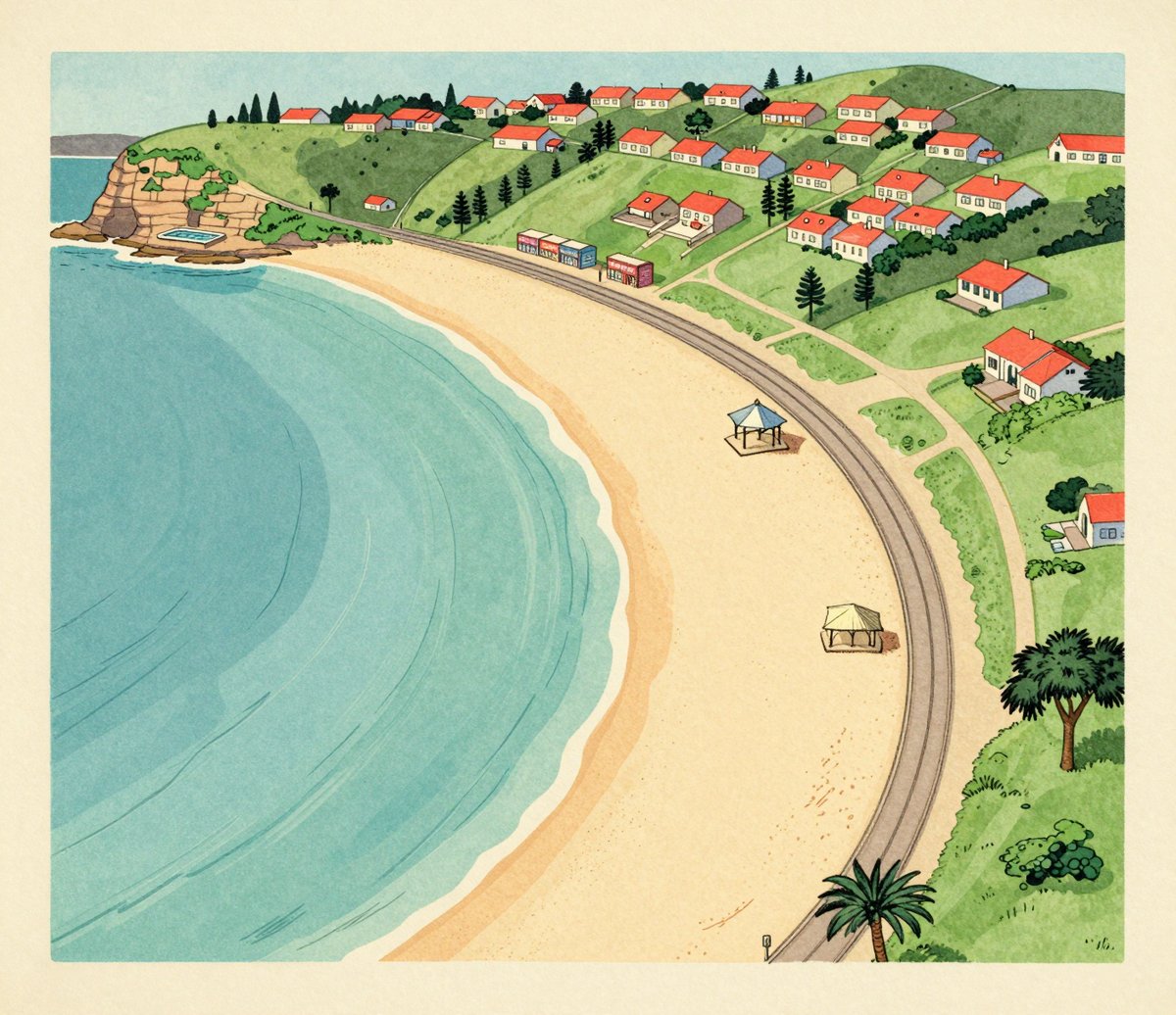
The whole suburb from above: a mile of sand, the promenade and the road along the back of it, and the streets climbing away behind the Parade. Nearly every book on this shelf happens inside this frame, and most of them within a few streets of each other.
Who you keep meeting
The series are separate stories in a shared suburb; the crossings are cameos, never homework.
- Blue — a small Australian Terrier with a grizzle coat and ears that hear a tram three streets off. He belongs to Dot, and he turns up wherever the stories do. (→ Blue's Bondi Beat; the Agency sheet)
- Dorothy "Dot" Campbell — schoolteacher first, then the woman running the Bondi Community Detective Agency out of a notebook. The quiet centre of the whole world. (→ Meet the Locals: the Agency)
- Kit Moran — reopened her late husband's veterinary rooms as The Wagging Tail, and walks half the dogs in Bondi before breakfast. (→ Meet the Locals: The Wagging Tail)
- Dru Mercer — sets the crosswords for the local paper. Spent the war doing something rather harder with the same skill. (→ Meet the Locals: the Cryptic Mysteries)
- Siobhan Murphy — keeps her mother's dance studio going on a cashbox that never quite balances. (→ Meet the Locals: Siobhan Murphy)
- Connie Reilly — the Bondi librarian, and the reason the reference alcove answers questions nobody else will. (→ Meet the Locals: Connie Reilly)
- Tom Brennan and the Icebergs men — the winter water, the handicap board, and a great deal left unsaid.
- Frankie Morrison — third desk from the bad window in the newsroom, holding on to it.
- Tess Treloar — brass fare-bag, the 47 down Bondi Road, and a conscience she can't put down.
- The other dogs — Hector, Rory, Hal, Argus, Moss, Ink. Each belongs to somebody, and each of them notices first.
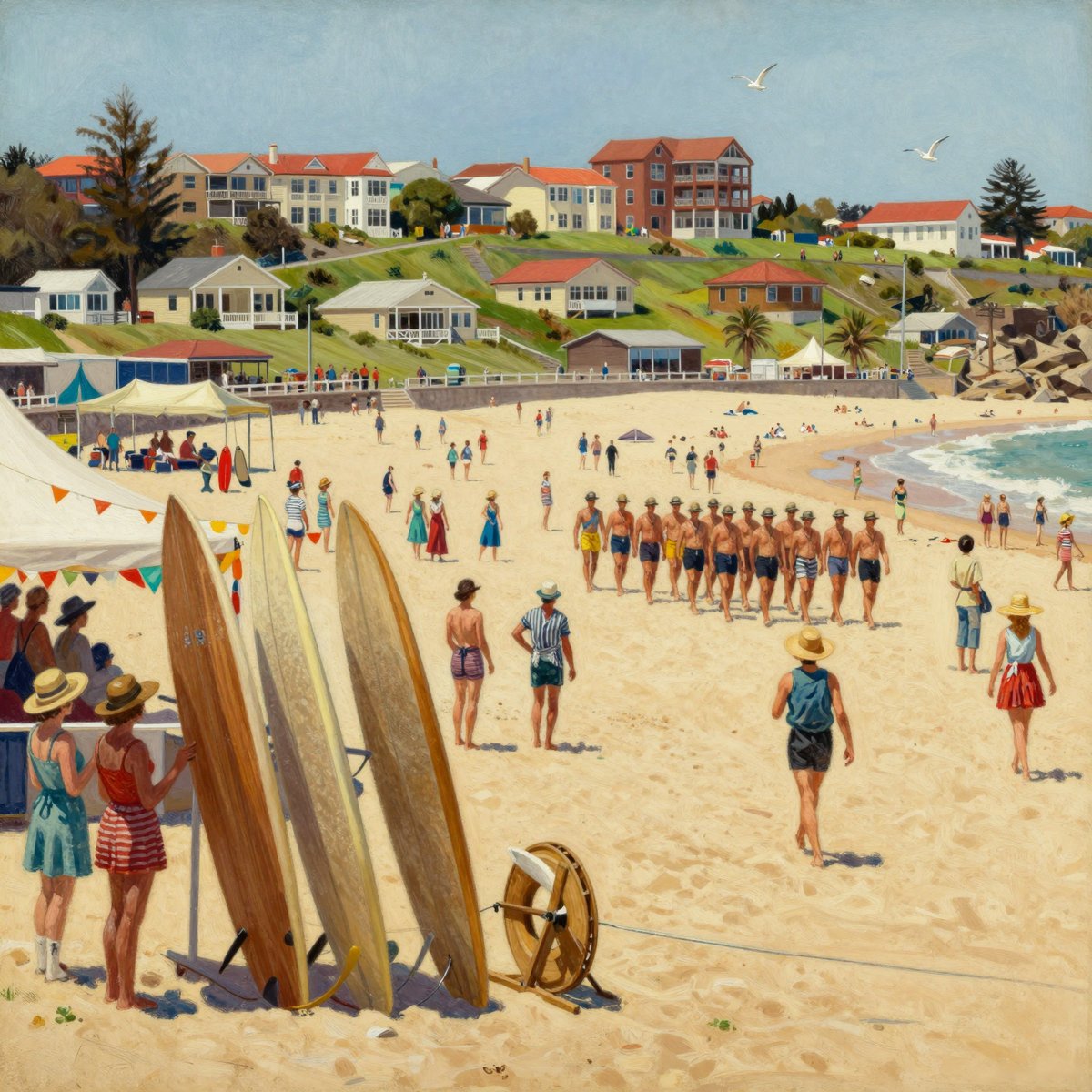
Carnival day. Boards up, the reel on the sand, and the whole suburb down to watch the same men they queue behind at the shops the rest of the year.
What this world promises
Warm, watchful and small in scale, even when the stakes are not. Most of these books turn on a livelihood, a good name or a missing person rather than a body — some do turn on a body, and say so on the cover. The answers come from noticing, never from forensics. Grief is present throughout and is never tidied away. Nobody fires a gun.
Where to start
Start anywhere. Every series is complete in itself, and the crossings are a pleasure, not homework.
- The short way in — Blue's Bondi Beat: twelve short mysteries at a terrier's height.
- The main door — The Bondi Pavilion Mystery, book one of The Bondi Community Detective Agency, 1947. If you read one book to find out whether this world is for you, read that one.
- The long way round — The Missing Pets, book one of The Wartime Anthology, which opens in 1939 and lets you watch the whole world grow up into everything above.