
The round, at the top of a hill above the water: a loaded basket, a bicycle propped against a brick pier, and the whole of the patch laid out below it. Every parcel on this sheet is somebody's business, and about one a book turns out to be somebody's secret.
The patch
The mail, and every household it opens. In 1946 the war is over and the post has gone mad with it — demob paperwork, war gratuities, parcels from England, coupon goods moving sideways — and the Bondi Beach Post Office invents a position for the parcels that fail: Delivery Enquiries Assistant. Rhoda Sixsmith ran parcels through six blackout years on a bicycle, was retrenched with a handshake in '45, and is re-hired into the job nobody wanted.
She carries a letter on PMG letterhead authorising her to make reasonable enquiries of addressees, their households and their staff, for the purpose of effecting delivery. It is a period-perfect skeleton key into the houses of the famous and the back offices of businesses, and it authorises questions about the parcel and nothing else. Half of every book is her working its edge.
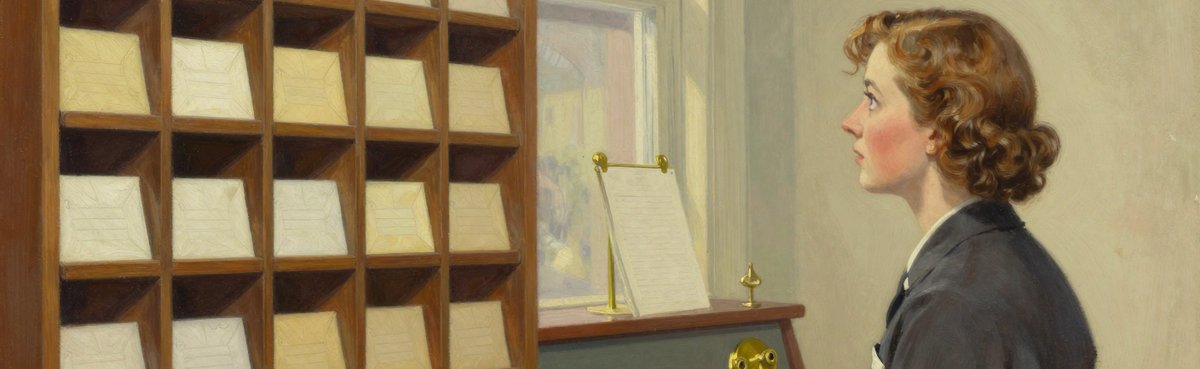
The working side of the branch: the sorting racks, the delivery book, and the desk they found for a job they had just invented. She is not at the counter. She is behind it, which is the whole difference.
The set
- The Bondi Beach Post Office — the branch — a cupboard-sized enquiries desk wedged in behind the sorting racks, the counter brass, the delivery book, and the postmaster's complaints spike.
- The Manolis fish and chip shop — vinegar and hot fat and yesterday's newspaper, on Campbell Parade. Her Friday-night fixture, and where she lands whenever the department drops her.
- Campbell Parade — the streetscape spine — awnings, shopfronts, and Col Carmody's ladder propped against a different one every book.
- Col's workshop — sawdust, shavings, and one narrow shelf exactly the size of a parcel bag that nobody ever remarks on. The quietest room in the series, and the site of its two loudest scenes.
- The harbourside houses — the delivery country of the famous: tradesmen's entrances, kitchen doors, back corridors. A woman with a parcel is invisible and expected.
- The round itself — bicycle, van and foot; brown paper, string and franking. The moving location every book comes back to.
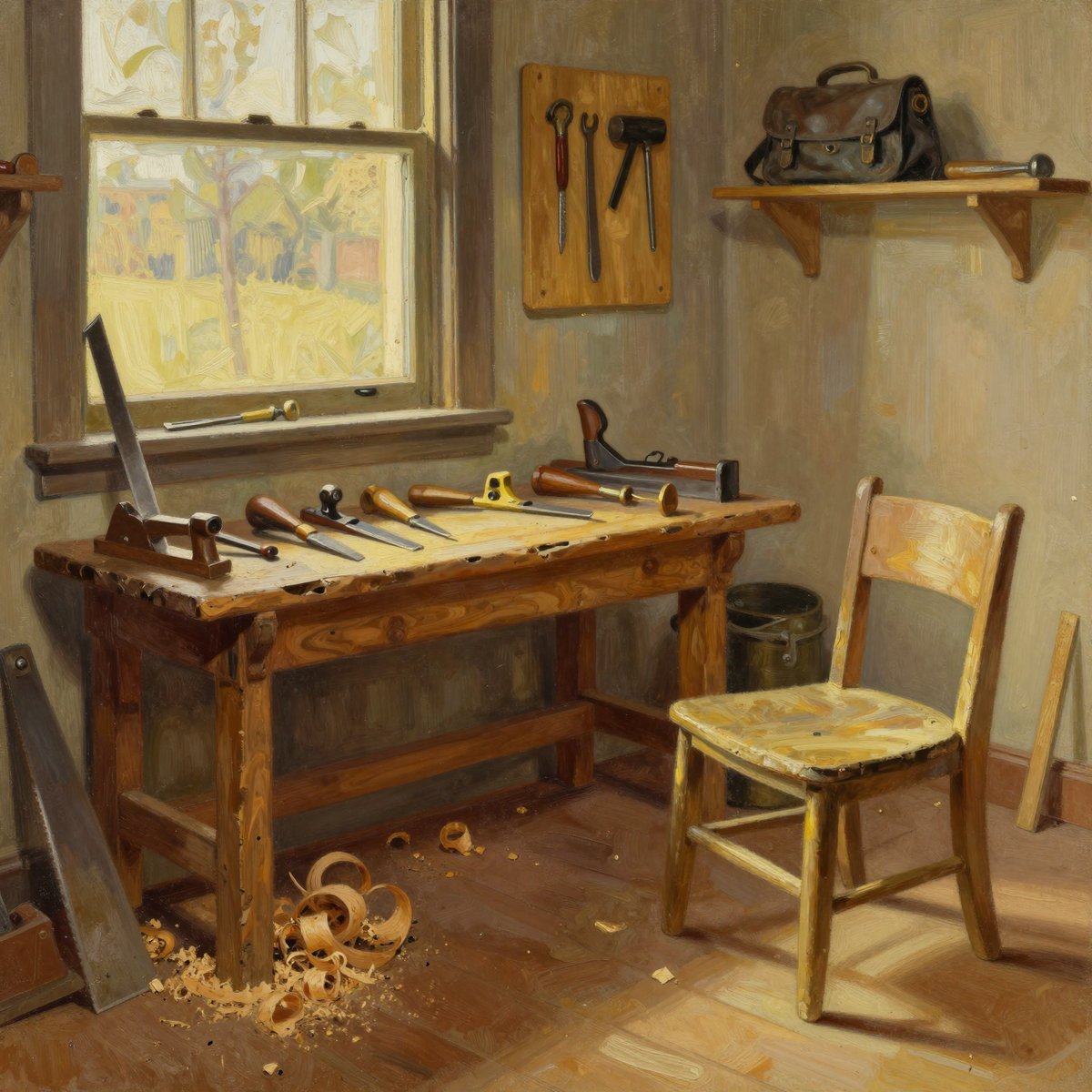
Hand planes laid in a row, shavings on the floor, and one narrow shelf on the wall that is exactly the size of a satchel. Neither of them has ever mentioned the shelf.
The cast
Told in one voice, Rhoda's. In brief:
- Rhoda Sixsmith — twenty-six; trim and spare off six years of delivery bicycles, chestnut hair pinned in a working roll, grey-eyed, with the reddened hands of a woman who ties parcels for a living. Nothing arrives without a reason and every irregularity means something — which is a gift at a desk and a menace when she turns it on men.
- Col Carmody — twenty-eight, a carpenter, broad-shouldered and easy with it from ladders and morning swims. A schoolfriend so old he is furniture. He is building one man and a van toward something respectable and will not say a word until it is established; she will not be pitied into anything. In book eight they both stop pretending, and the new shingle reads Sixsmith & Carmody.
- Angus Considine — the postmaster: fifties, spare and dry-kept, spectacles, grey going white at the temples. He invented her job, is proud of her results and frightened of her methods. His standing instruction is to deliver the parcels and not to deliver disasters.
- Val Hogan — her best friend and the chorus's voice — blunt, unarguable, sleeves pushed up, hair out of its pins by mid-morning. They break in book three and mend, and she is blunter afterwards.
- Mrs Manolis — the fish shop's matriarch, broad and grey and aproned to the throat. The hearth of the series: Friday nights kept, lunches sent over, love arriving wrapped in newspaper.
- Figgis — the telegraph boy, who sees everything, and is the best-placed eye in the district.
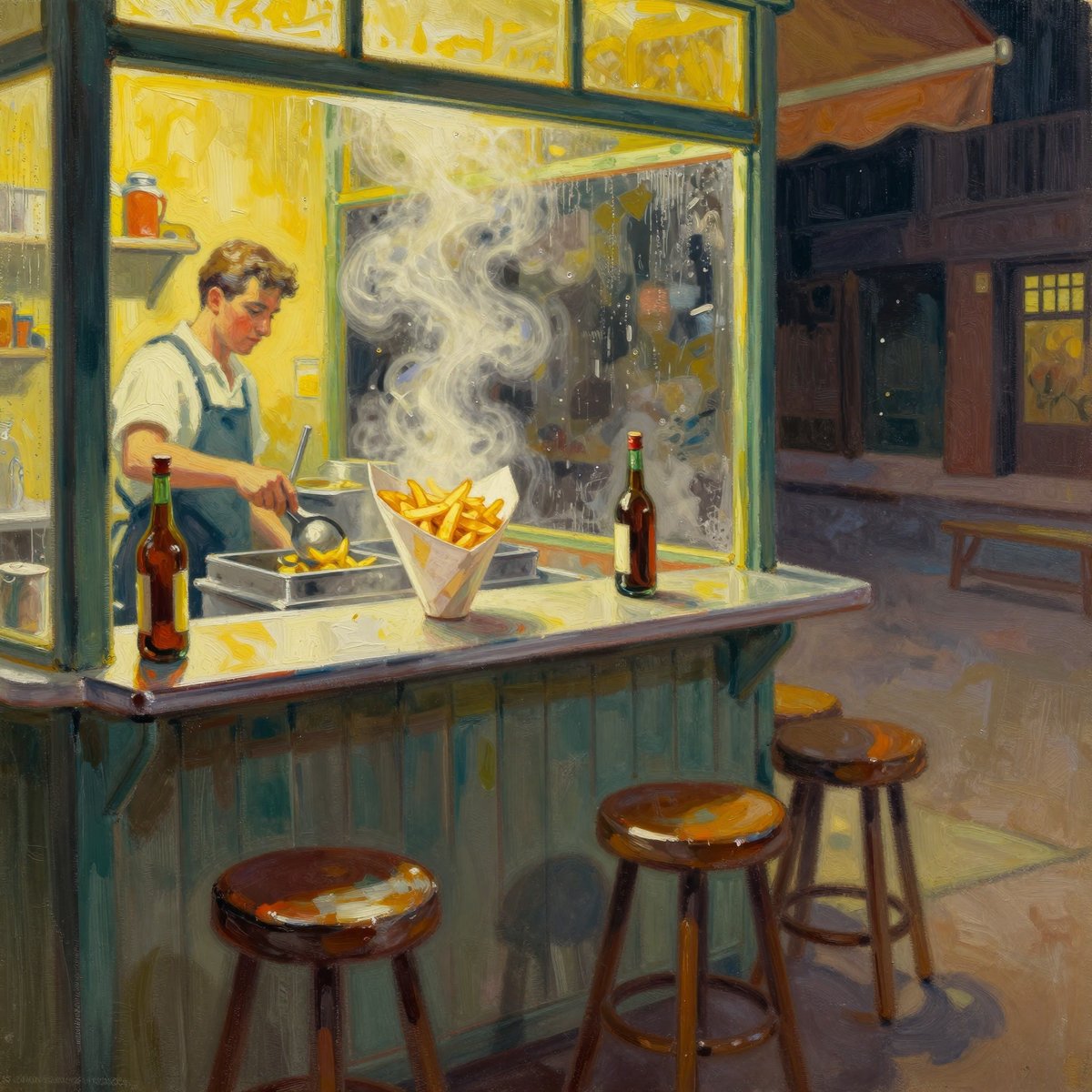
Hot fat, vinegar, a fryer going and the window fogged against the dark street. Officially a fish shop. In practice the place she is fed when the department has finished with her.
The rhythm
Eight non-murder cases. Nobody dies. A parcel fails in a strange way, the strangeness turns out to be a symptom of something hidden, and completing the delivery means solving it — fair play throughout, in the shape of a false assumption, then the evidence that will not fit, then the reveal that reframes.
Two things run underneath. Rhoda's worm doctrine, that every man hides a flaw and an absence of evidence only means he hides it well, which is validated early and dismantled by casework rather than by lecture. And the war's real business: the era unmade people's names, and most of these books are about a name being put back.
The question the series asks
What do you owe a stranger whose trouble arrives in your care?
Where to start
Each parcel is a case complete in itself, but Rhoda's doctrine and her job both move across the eight, so the order pays.
- Return to Sender — start here. A registered parcel a radio star's servants have refused three times, a ring, a manufactured past, and a charming man whose warmth is a shopfront. She completes the delivery and acquires a reputation she never advertised for.
- A Particular Shade — a famous painter's custom red arrives signed for, correct on paper and wrong in the tin, and the man who mixes it has gone south with the recipe.
- Money for the Dead — a war-gratuity order made out to a man the army listed killed in 1943, and lodged in person this year.
- Postmark Megalong — four parcels in an old-world hand, franked on the same two days each year, addressed to a name that does not exist in a Blue Mountains valley. The quiet one.
- Missing in Transit — registered mail vanishing between the city and the branch, and a paper trail that points inside her own post office — then at the man who gave her the job.
- No Fixed Address — a parcel posted in 1944 to a man with no address but the fishing shack, from a woman two years dead. Worked by dinghy, along the coast.
- Deepest Regret — painters shift a cabinet and find a death telegram franked March 1943, never delivered, addressed to a mother three streets away who is still waiting for her boy. No crime here at all — only the question of who could not bring himself to knock.
- Signed For — the last one. Her position is quietly wound up, and she is handed the oldest live file in the state.