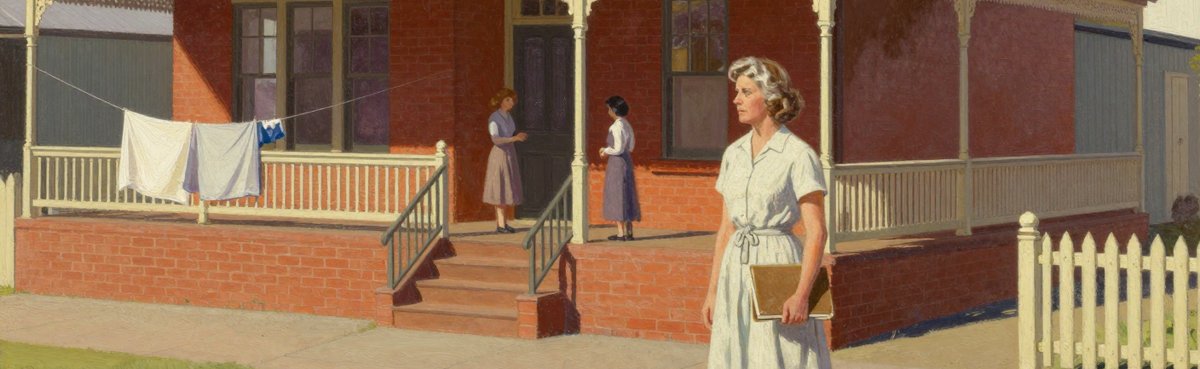
Bondi View from across the road, and the woman whose name is on the paperwork: brick and render, a wraparound verandah, washing on the line, lodgers talking out the front, and the sea behind the roofline.
The patch
One address does nearly all of it: a big two-storey house on Campbell Parade with a wraparound verandah, sea over the rooftops from the upper rooms, and a coke stove that goes on before anyone else is up. Nora Hargrave inherited it from an uncle who died on war service, and turned it into a guesthouse that takes the lodgers nobody else will.
That is the whole patch, and it is deliberate — the tram goes past the front fence, the baths are five minutes down the hill, and almost nothing in these six books needs to leave the building. The post-war world arrives at the door instead: displaced-persons paperwork, ten-pound Poms, a policy that decides who counts as Australian, and women with nowhere to put their names.
The set
- The verandah — salt-bleached boards, cane chairs, the sea over the red rooftops. Where the difficult conversations happen, and where the series ends.
- The kitchen — the coke stove, the big scrubbed table, the tea urn. The actual heart of the house — most of what gets decided here gets decided over that table.
- The parlour — horsehair sofa, a good wireless, net curtains. It changes job across the books: sanctuary, then a co-op hall, then a schoolroom.
- The upstairs rooms — narrow beds, a jug and basin, thin sea light through the curtains. Small, clean, and for several of the women who get one, the first door they have been able to shut.
- Campbell Parade — the tram rattling past, the milk bar, the greengrocer, the salt wind. The address, and the reason the house is respectable enough to be worth attacking.
- The sea baths and the foreshore — cold green water and the morning regulars, five minutes down the hill. Somebody in this house swims there every dawn without fail.
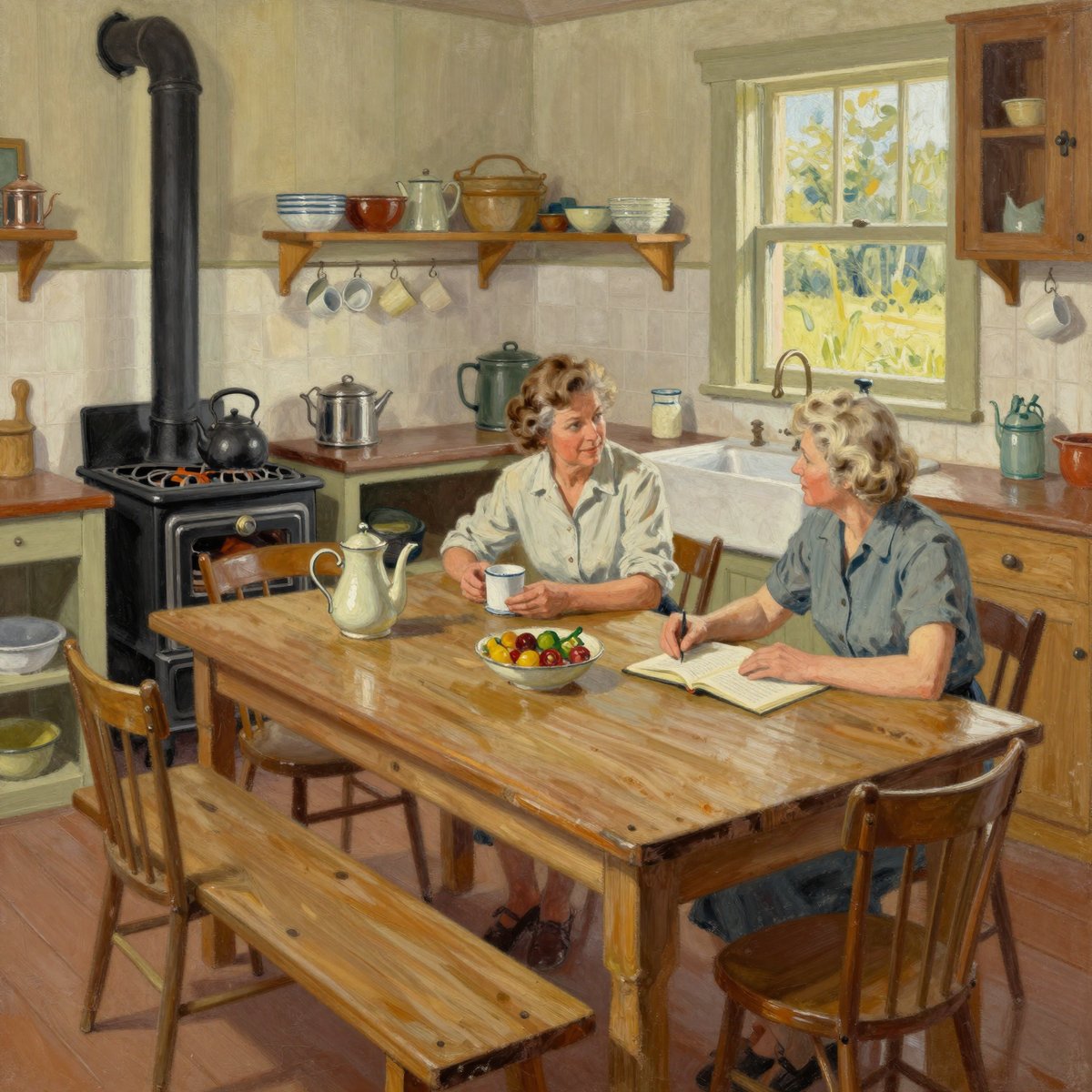
The stove, the long scrubbed table, two cups and the account book open between them. Most of what gets decided in this house gets decided sitting here with the kettle going.
The cast
A women's-fiction ensemble: one anchor, one new arrival per book, and one man who is simply always there. In brief:
- Nora Hargrave — a records clerk at a munitions works until the men came home and she was dismissed. She runs the house, and her real weapon is paperwork — she knows which official to write to, in what words, and what a form can be made to do.
- Eddie Rivers — an Aboriginal ex-tracker, quietly injured, who takes a room in book one and stays. He fixes what is broken, says very little, swims every morning, and is the man she eventually marries. He saw her the whole time.
- Elsie Hart — the first lodger and then the right hand — offered a menial job and a marriage ultimatum, and choosing the guesthouse over both.
- A new arrival every book — a Latvian displaced person, an ex-WAAAF organiser, an Iraqi refugee teacher, a nineteen-year-old brought out from England on a promise. Each one carries her own book's emotional arc, and each one leaves the house changed.
- The women who came before — nobody exits this series. Former lodgers keep turning up in later books, which is the point of the place.

Salt-bleached boards, two cane chairs and a pot of tea, the red rooftops and then the sea. The series ends here, with both their names on the paperwork — and it is worth knowing that going in.
The rhythm
Six standalone-but-linked novels, and the engine is arrival: someone comes to the door with nowhere else, and her story is the emotional spine of that book. Alongside it each book carries a fair-play, reader-solvable puzzle — but a bloodless one, a puzzle about people, usually something in the paperwork that will not reconcile. There is no body and no crime thriller here.
Nora's own arc runs underneath all six, from invisible to formidable, and the romance is the slowest in the whole Bondi universe: a man who has been standing there since book one, waiting to be noticed, and six books before she does.
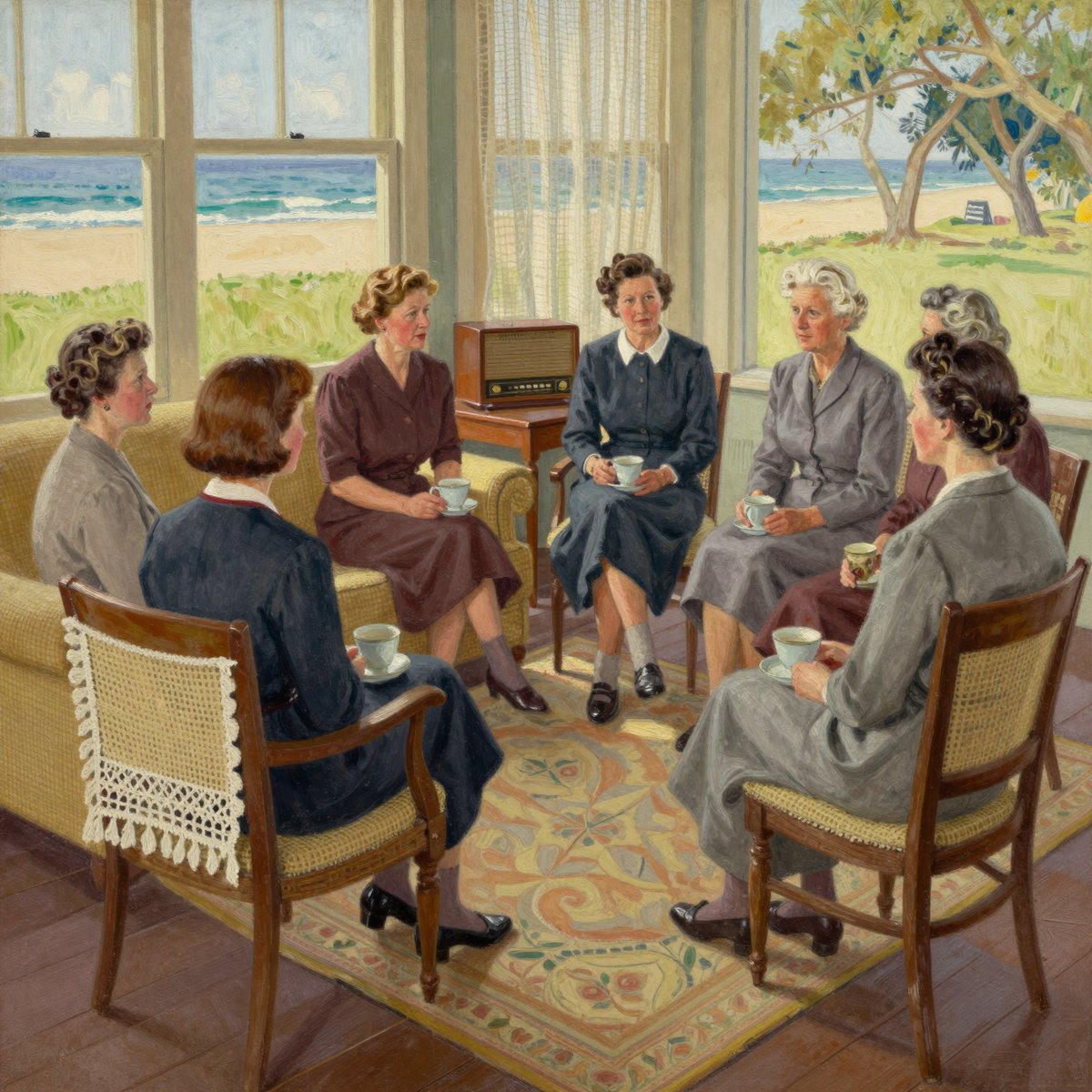
The parlour doing one of its jobs: a circle of mismatched chairs, teacups on knees, and a room full of women deciding something. It is a sanctuary in one book, a co-op hall in another and a schoolroom in a third.
The question the series asks
What does it cost to be the person who is never the one being looked after?
Where to start
Each book belongs to its own arrival and reads on its own, but Nora changes across all six in one direction, so they reward being read in order.
- The Ledger — start here. Nora opens the house, the first lodger chooses it over a marriage ultimatum, and a quiet man asks for a room and is given one without questions.
- The Borrowed Name
- The Public Room
- The Children's Hour
- The Empty Stage
- The Verandah — the last one. The guesthouse itself is threatened, every woman who ever lodged there comes back for it, and Nora finally sees the man who has been standing beside her since book one. They marry, and both their names go on the paperwork.