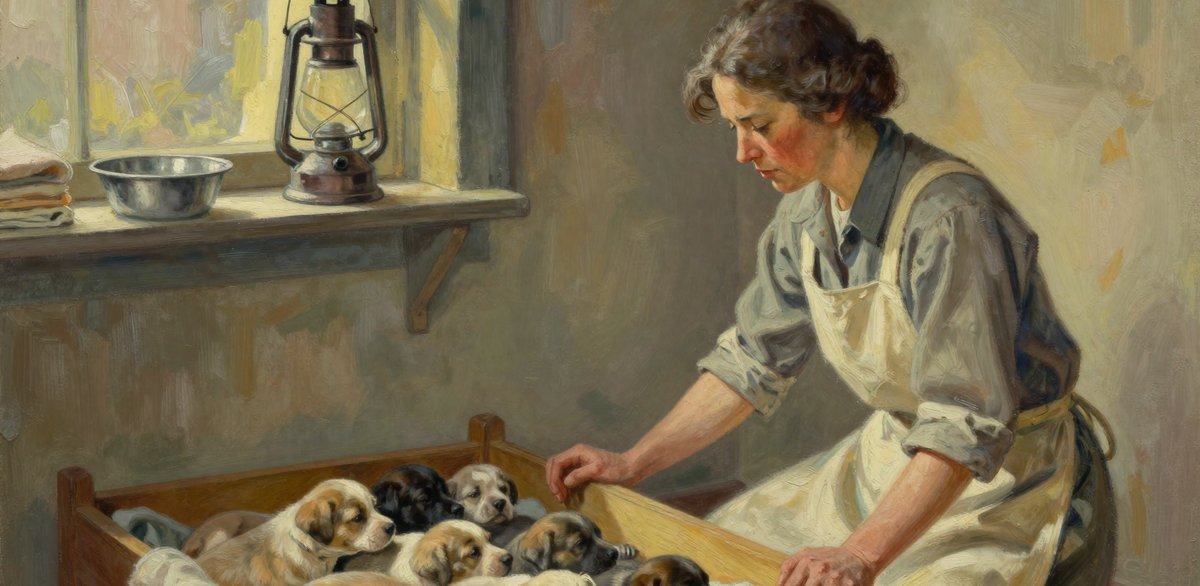
First light in the back room of a veterinary practice that has not been one for four years: a low timber box, folded blankets, eight sleeping puppies, and a woman with eight weeks to find homes for all of them.
The patch
Bondi, 1948, and Kit Moran's slow burn is over. Harry Emerson proposes in the opening chapters, the wedding is eight weeks off, and after it a caravan and a year on the road visiting dog clubs, booked and paid for. Then an elderly client dies and leaves Kit her dog, and the dog has just whelped eight puppies. She cannot take nine dogs in a caravan. She cannot sell them, because the nephew says they are estate assets. So: eight weeks, eight homes, one a book, and the last puppy goes days before the wedding.
Vetting a home is licensed snooping. You are invited through a stranger's back gate to see where a dog would sleep, and whatever the kitchen has to say gets said in front of you. The placement is not a subplot running beside the mystery. It is how the mystery arrives.
The set
- The Wagging Tail — her late husband's veterinary rooms, his name still ghosting in gold through a newer coat of paint on the front window, and a whelping box in the back room for eight weeks.
- The morning walking rounds — six leads over a shoulder at a quarter to six. The moving location every book returns to, and Kit's whole listening post.
- The applicant's kitchen — the recurring room of the series — a back door opened to a near-stranger because a dog needs seeing where it would sleep.
- The foreshore at dawn — cold firm sand and low surf, and the country of the one pup that will not stay out of the water.
- The solicitor's letter on the counter — not a place but the series' recurring object: the paperwork that made Marguerite Crowther, and unmade her.
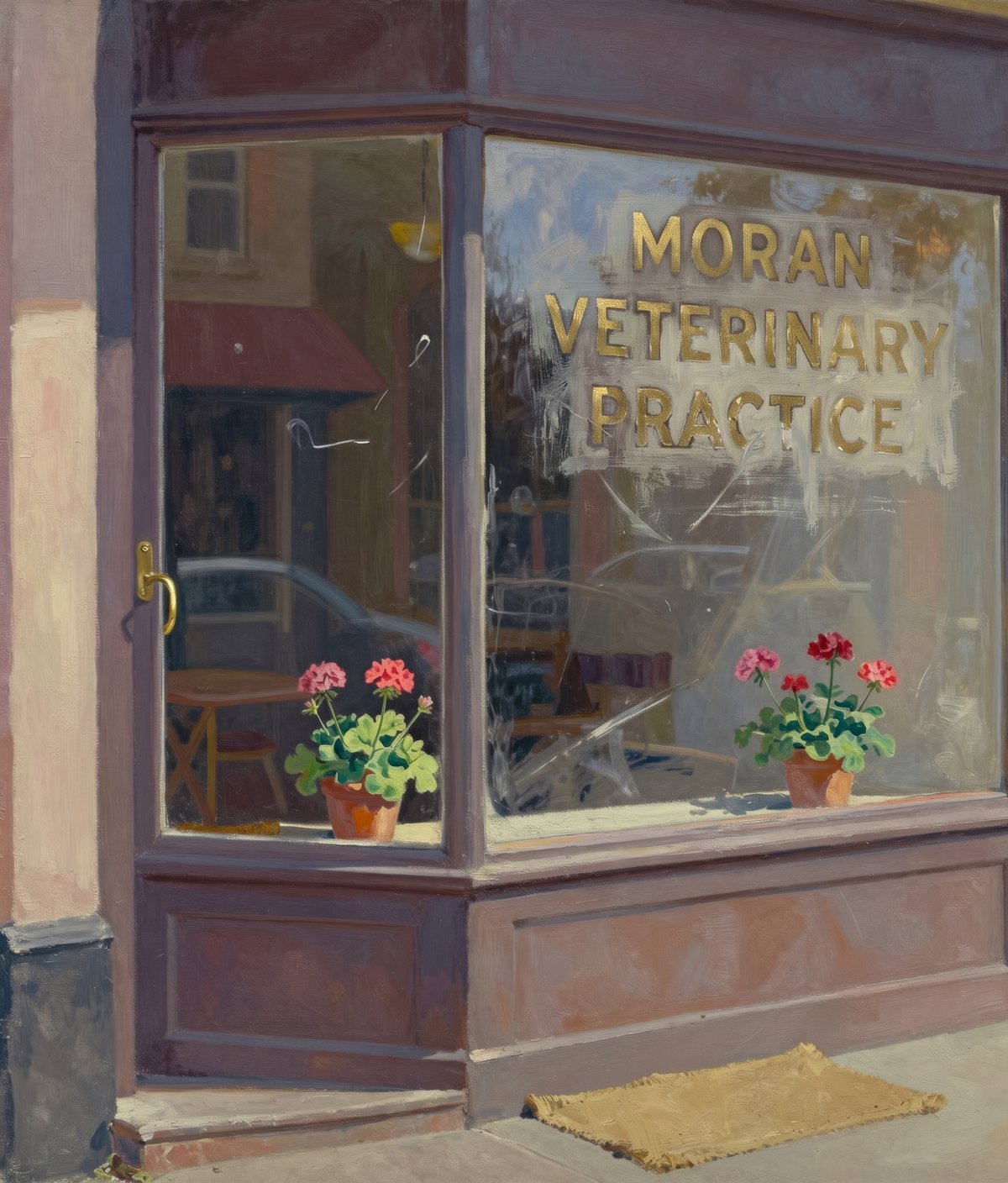
Nobody has painted out the old gold lettering, and nobody has said why. It is the only thing on the premises still carrying his name.
The cast
Told in two voices a book — Kit's, and that book's walker. In brief:
- Kit Moran — twenty-nine; tall and broad through the shoulder, a long weathered face, dark hair going grey at the sides, big scarred nurse's hands. A war widow who kept her husband's practice going as a walking round. She refuses to name the puppies, because naming is keeping.
- Harry Emerson — late thirties, a carpenter's build, sun-lined, grey at the temples, always something in a pocket with sawdust on it, and a shortened stride he has never once mentioned. He proposes in the first chapter, the caravan is his idea and hers, and they marry on the last page.
- Marguerite Crowther — the dead client — late seventies, small and spare, hands wrecked by forty years of dogs and cold water. She bred this litter deliberately while she was dying. The bequest is an instruction, and it takes Kit eight books to read it.
- Cecil Bewley — the nephew: early fifties, tall and narrow, holding himself vertical like a man in a queue he expects to be moved out of. He presses the estate claim in all eight books, and is never once cruel to an animal.
- Juno — an English Cocker of six, liver and white, feathered legs permanently sandy, a liver patch over the left eye. The bequest the will actually names, and the one Kit keeps.
- Hector — Kit's own: an Irish wolfhound mix, seven, enormous, greying through the muzzle. He leans, and he chooses whom.
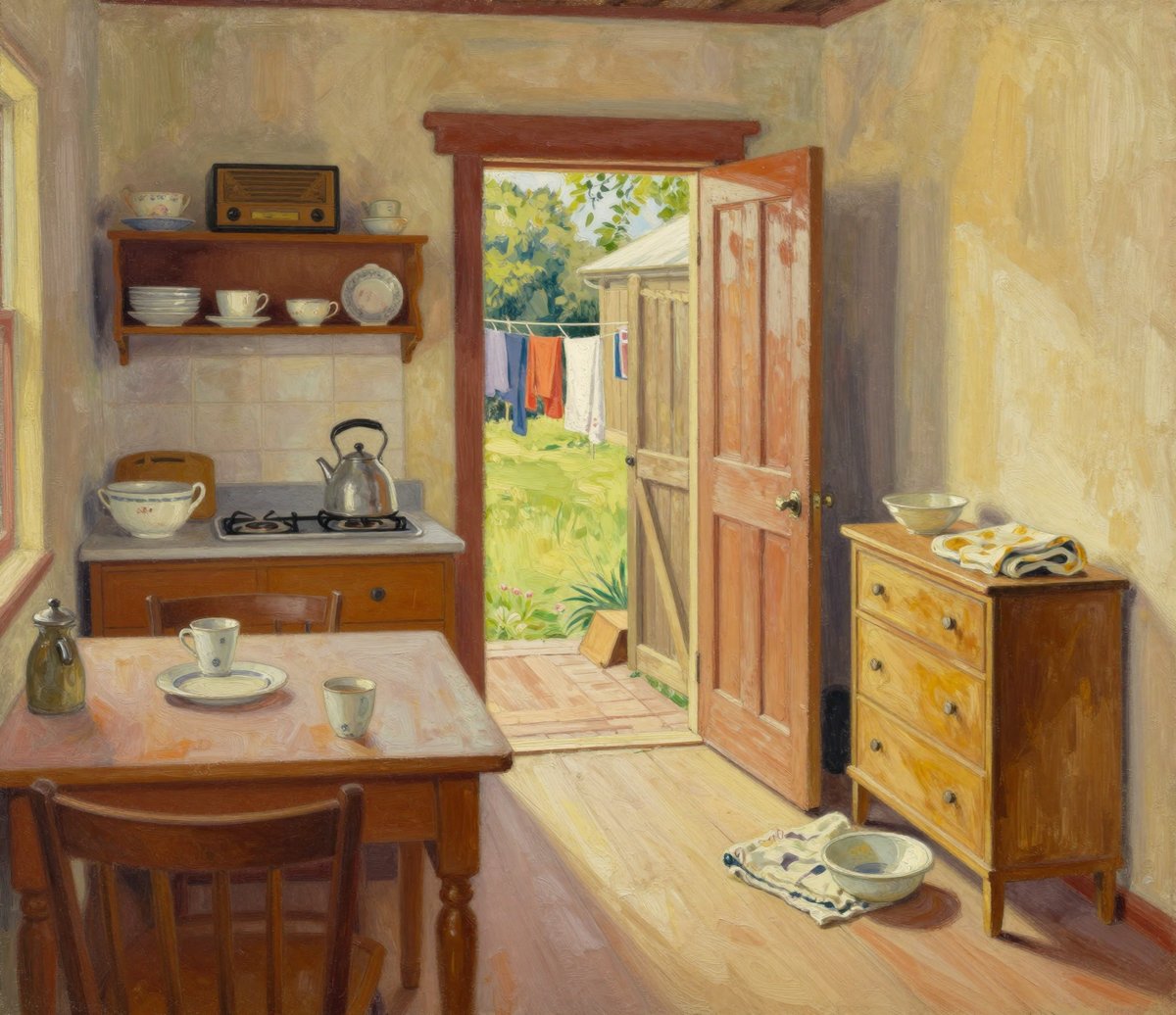
Two cups already set out, the kettle on, the back door open onto the line and the gate. This is the room the series happens in: a stranger's kitchen, and a reason to be standing in it.
The rhythm
Eight books, roughly a week each, bloodless by contract. Every book asks two questions and the reader plays both — who did the thing, and who gets the puppy. Neither answer is a coincidence: the pup is placed off a trait and a need you were shown, and the home is never the obvious one.
No body, no arrest, no sceptical lawman. Wrongs surfaced by a vetting visit get resolved privately: restitution, an apology, a door closed, a home refused. Under the comedy runs a quiet elegy, because the series is about a woman who was placed once, badly, and then spent forty years doing it properly.
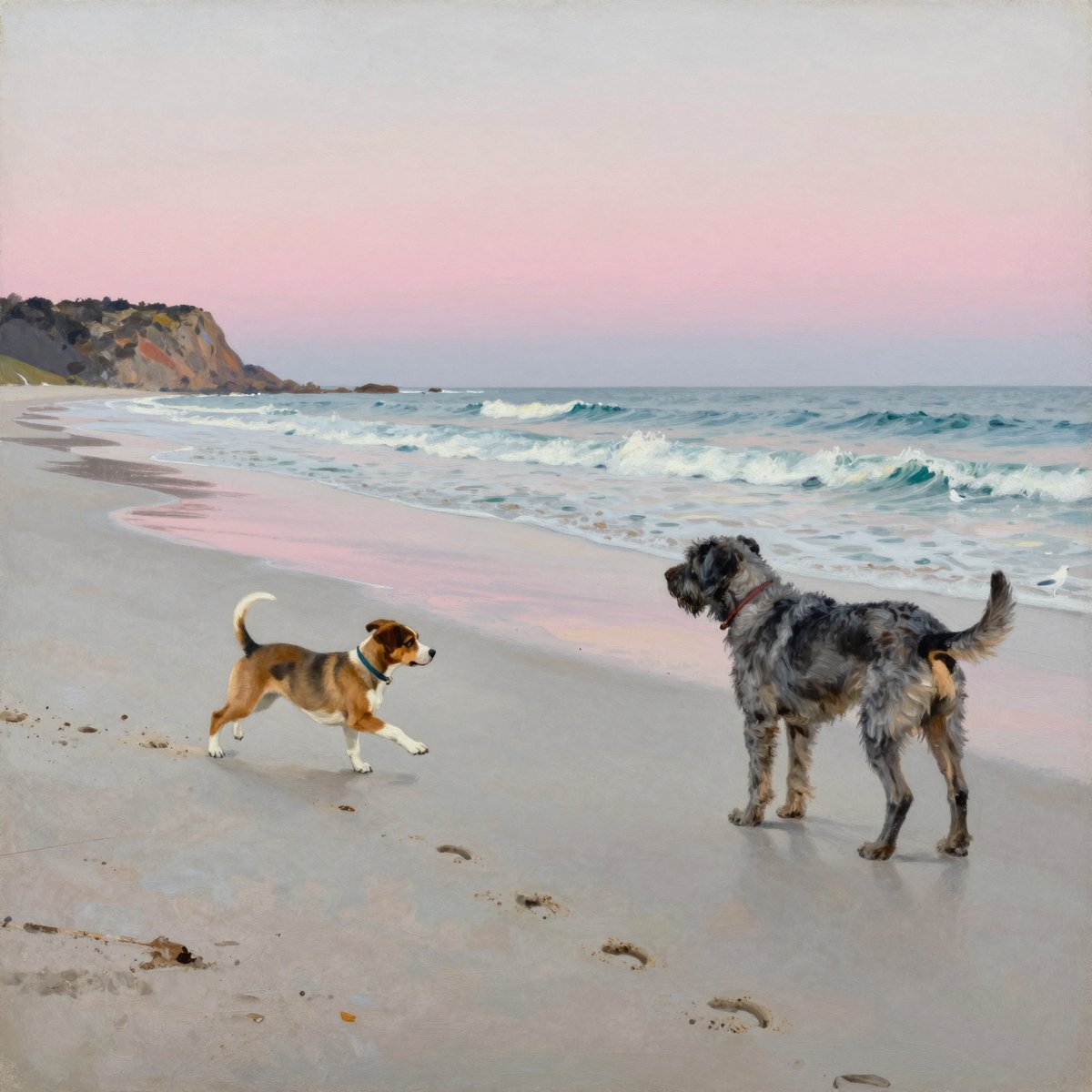
Cold sand, low surf, a pup at full stretch at the edge of a wave, and the big grey dog who has decided to allow it.
The question the series asks
What do you owe someone who chose you before you knew it?
Where to start
One puppy a book and about one week a book. The count only goes backwards once, so read them in order.
- The Whelping Box — start here. The proposal, the death, the litter — and the corner shop where the Christmas club tin is four pounds eleven short.
- The Slipped Collar — timber gone from a locked store at the parish hall, and the young caretaker who holds the only key loses his position on the Sunday.
- The Scale and the Ledger — the butcher's counter scale runs two ounces light. Her own scales disagree with it, and with each other.
- The Waterline — a water-mad pup takes her into the surf club the week a man is honoured for bringing a boy out of the sea. The boy has not been back in the water since.
- The One That Came Back — a puppy she placed in April comes back, and her page in the file is marked RETURNED. Two homes to find, and an unsigned letter costs a good barman his living.
- The Good Address — a mason is refused a small loan in four typed lines over no signature, and the fund's own visiting book lists twenty-seven households no committee ever heard of.
- The Hand Signal — twelve days out, one puppy left, and the white one is deaf. Four households have sold themselves up in five weeks and every sale made a poor total.
- The Last Good Home — five days to the hearing, and a letter reaches the solicitors in the dead woman's own hand. All Bondi knows who sent it, and so does Kit, and Kit is wrong.
These are Kit Moran's second eight books. The Six O'Clock Leads comes first and is where the round, the walkers and Harry began — but the eight weeks start here, and this is a clean place to come in.