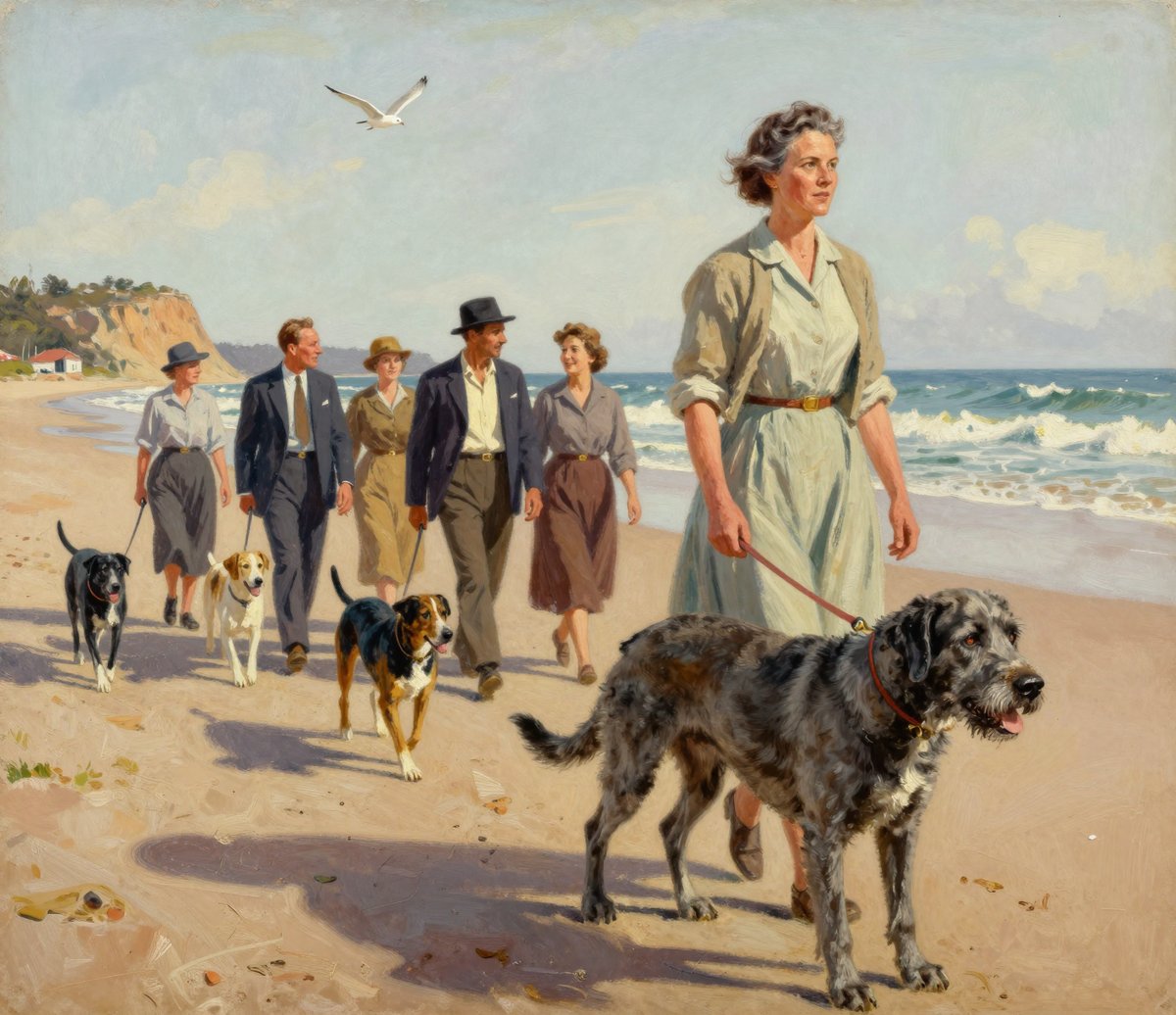
The morning walk on the firm sand, a little after five: Kit out in front with Hector, and behind her seven or eight people who did not set out to form anything and now turn up every day without being asked.
The patch
This is the same square mile a year or two on, and the difference is that Kit Moran no longer has to walk dogs to eat. The Wagging Tail is a going concern with boarders in the yard and staff in by six, and the freed-up hours have gone somewhere nobody planned: a loose standing walk that meets at the shopfront, crosses to the Pavilion and finishes at the Icebergs kiosk.
That is the patch — three fixed points and the routes between them. Nobody organises the Bondi Walkers and nobody is in charge of them; people simply turn up at five, and the troubles in these six books all arrive the same way, walking in beside somebody who came for the company.
The set
- The Wagging Tail — the converted veterinary rooms, now a business with boarders in the yard and leads on a hook by the back door; where the walk starts, in the dark, at five.
- The Bondi Pavilion and its noticeboard — the stucco arches, and the cork board under them where the whole suburb pins what it wants and what it has lost. Half a plot begins as a square of paper.
- The Icebergs kiosk — the tin-shed era, unlicensed, an enamel mug of tea and a bench in the spray; where the walk finishes and the talking actually happens.
- The foreshore and the cliff path — firm sand at the waterline and then the climb, and a headland that turns a walk into a confidence.
- Clients' homes and back gates — the old round, still walked. Kit is a business owner now and still knows which pot the key is under.
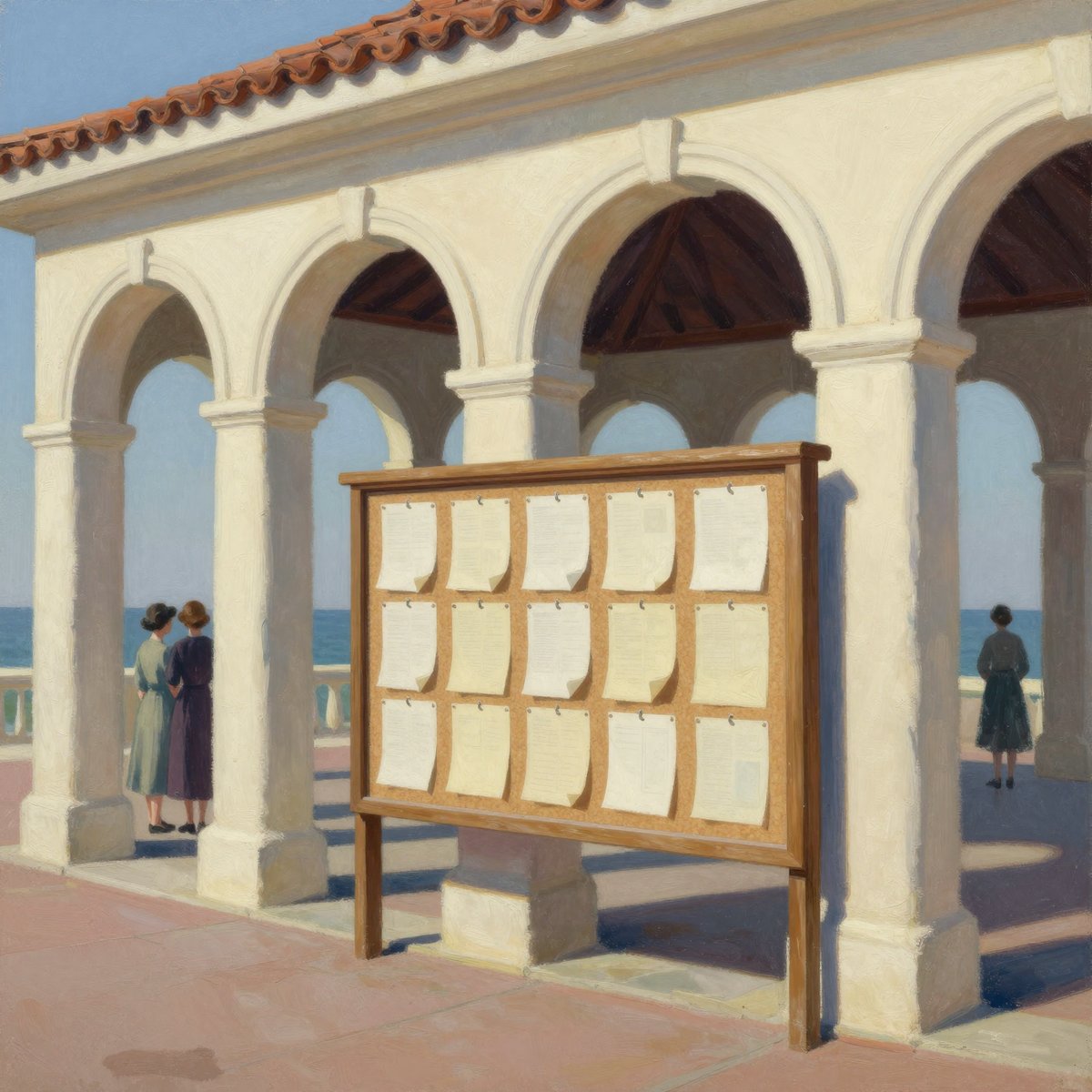
The board under the Pavilion arches, where the whole suburb pins what it wants, what it is selling and what it has lost. In this series that is where a plot usually starts.
The cast
Kit and Hector carry over from The Six O'Clock Leads; everyone else you meet here is either paired off by now or brand new. In brief:
- Kit Moran — about thirty, tall and broad through the shoulder, dark hair greying early at the temples, a nurse's hands. Widowed young, and now — awkwardly, having got very good at managing alone — being courted. Her flaw in these books is not grief; it is that she cannot let a day be about her.
- Harry Emerson — carpenter and builder, a slight limp from shrapnel, and her late husband's boyhood best mate. Steady, funny, entirely certain, and the man she marries. The obstacle between them is the practical comedy of merging two self-contained lives — not a ghost and not a misunderstanding.
- Hector and Nails — Kit's very large rough-coated wolfhound cross, who herds the whole pack without making a sound and drags her to the rocks whenever there is surf; and Harry's small mixed rescue, whose opinion of Kit is the most reliable barometer in the series.
- A new walker every book — one per book, and deliberately a wide pool — a widow of thirty-five, a nurse, a shopkeeper in her fifties, a young migrant swimmer, a woman with no dog at all. She shares the telling with Kit and her own story resolves inside her own book.
- The standing ensemble — the original walkers, now largely paired off — Fran, Meg, Vi, Elsie, Dorry, Jo, Bee, Nan and the men they have collected, including a constable and a Herald journalist who turn out to be useful. Background community; never the culprit.
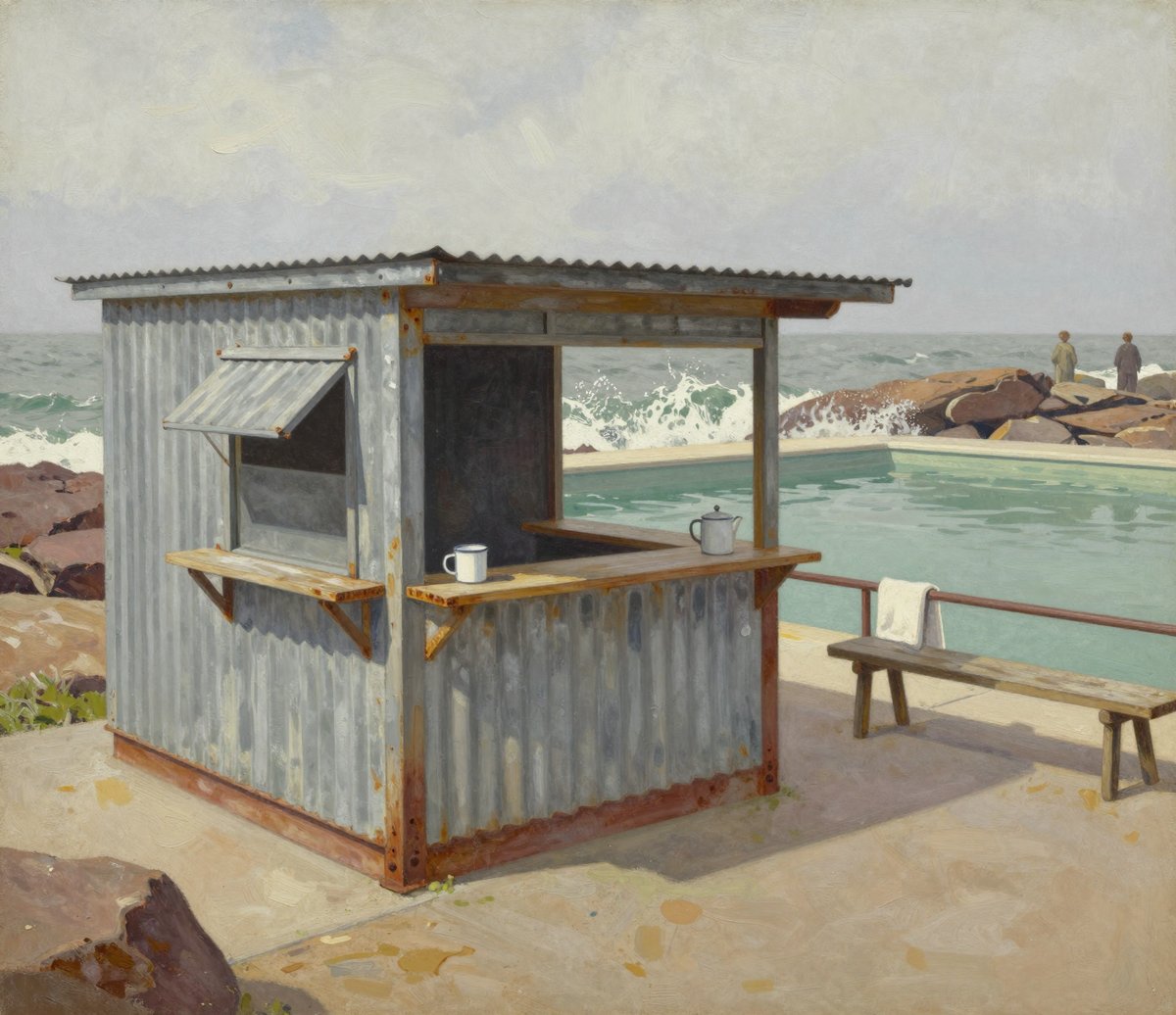
The kiosk at the baths in its tin-shed era: a propped hatch, a bare counter, an enamel mug and a bench in the spray. The walk finishes here, and this is where the talking actually happens.
The rhythm
Six books, closed at six. Each is a self-contained cozy mystery — bloodless, no body, nothing violent on the page — that arrives through the walking group rather than through a corpse: something taken, swapped, hidden or quietly wrong, usually involving somebody's dog. Two first-person voices take turns, Kit and that book's new walker.
The other half is warm and closed-door. The new walker's romance lands inside her own book; Kit and Harry's runs the whole six at the pace of two adults who each already know how to be alone — engaged by book four, married by book six.
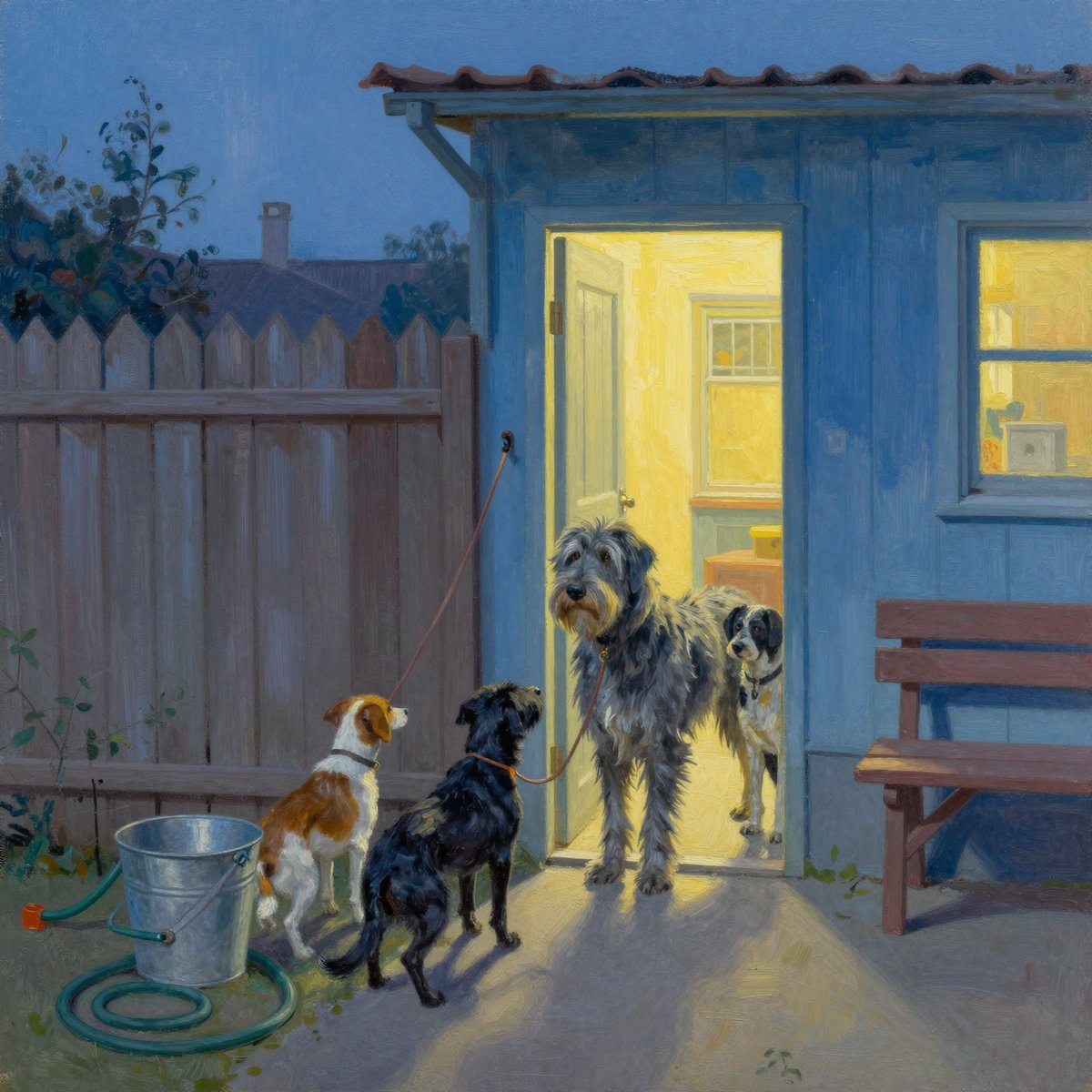
Five in the morning at the Wagging Tail: the back door open on warm light, the leads on their hook, and the boarders already waiting at the gate because they can hear the key.
The question the series asks
How do you let someone in when you have got very good at not needing anyone?
Where to start
Every mystery is complete in itself, but Kit and Harry's story runs straight through all six, so the order matters more here than in most cozy series. This is also a sequel — it reads perfectly well cold, and it reads better after The Six O'Clock Leads.
- The Walking Group — start here. The morning walk hardens into a standing group, a widow named Edith Pryor shares the telling, and the first trouble walks in with the pack.
- The Borrowed Dog
- The Lost and Found
- The Cold Water
- The Quiet Mile
- The Double Knot — the finale — a double wedding, the whole pack present, and one last small trouble determined to spoil the day.
For the beginning of Kit's story — the round, the empty shopfront and the first year — go back to The Six O'Clock Leads.