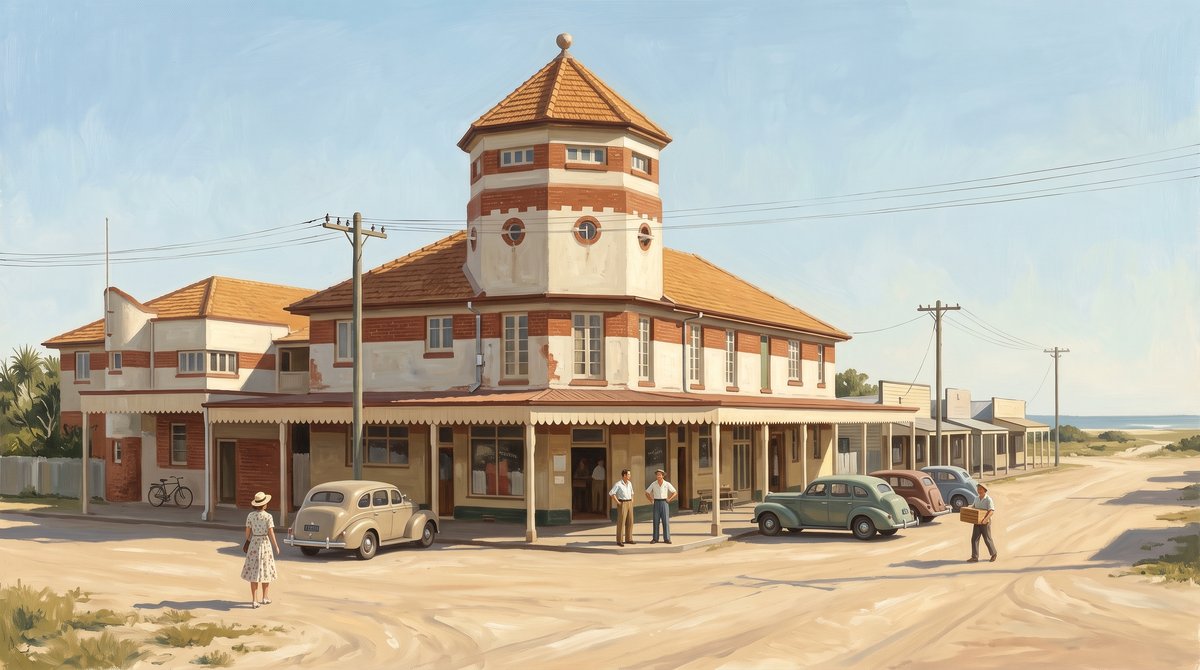
The hotel on the strip: two storeys, a corner tower, and a veranda deep enough to sit out the afternoon on. There are only a few hundred yards between the surf and the river, and for a while this building is most of what stands in them.
Standing line
Queensland, 1946. A strip of sand between the surf and the Nerang River, forty-five miles south of Brisbane, that nobody had yet thought to call the Gold Coast.
The place, physically
A narrow coastal strip, and almost nothing on it.
The surf beach runs broad and long and largely empty, and it clears fast after sunset. Behind the beachfront the land falls away west toward the Nerang River, which runs roughly parallel to the coast and makes the strip's back boundary: scrub, swamp, mangrove, tidal creek and flood-prone low ground where the suburbs will later be. Between the two, a few hundred yards wide in places, is everything — the hotel, the shops, the fibro cottages and timber houses and small guesthouses that a stranger cannot tell apart from the road, because a holiday let and a permanent home look identical from a car.
Cavill Avenue is the town: a short row of shopfronts and businesses that constitute the whole commercial life of the place. It was renamed in 1945, so 1946 is its first full year under the name.
Out past the built strip: sand tracks and newly formed roads, unsealed and badly drained, pegged across scrub ahead of the houses meant to fill them. Subdivided vacant blocks with survey pegs and nothing else, allotments going at around £600, low ground being filled with barrowed sand. And behind all of it the farms — bean rows running down from the road toward the flats, worked low and by hand.
The water matters, and it is the wrong water. The modern Gold Coast is defined by canals that do not exist yet: the artificial canal estates are a 1950s and 1960s development, and nothing in this world has canal frontage. What is there is a river with backwaters, natural creeks and tidal channels, sand flats and mangroves. The Broadwater, the sheltered estuary north of the strip, is period-correct and navigable. Across it lies South Stradbroke — the island was split in two by the Jumpinpin breakthrough, the final break coming in gales and very high tides in May 1898, which puts it inside living memory: a character of sixty was twelve when it happened.
The beach is the public water. The river is the quiet water. Most of what happens in these books happens on the river side.
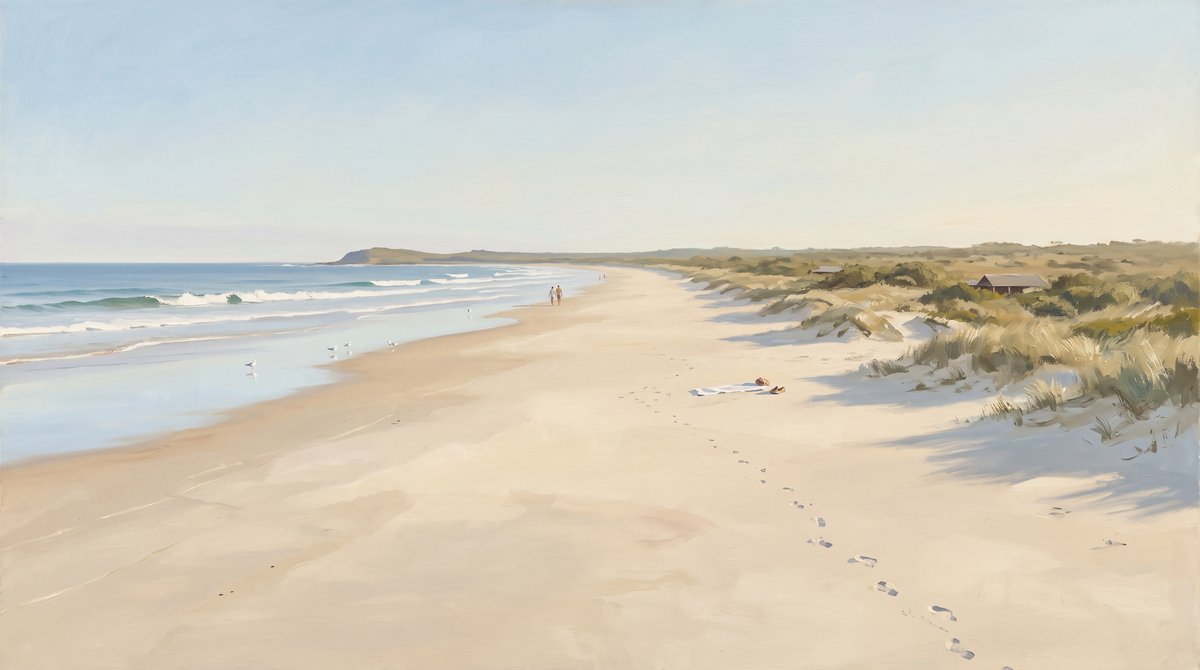
The public water. Broad, long, and empty enough that a set of footprints reads as information. It clears fast after sunset, and no building in sight stands above two storeys.
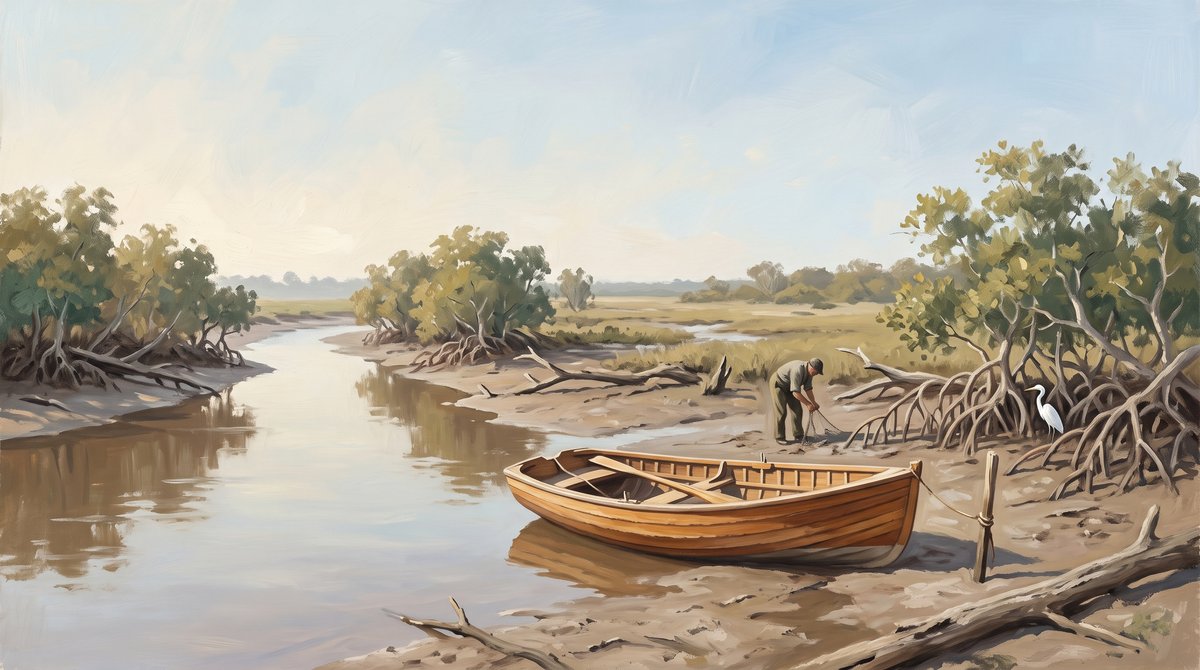
And the quiet water, a few hundred yards behind it. Mangrove root, tidal channel, a natural bank with no seawall and no canal edge anywhere — the canals are a decade or two off. Most of what happens in these books happens on this side.
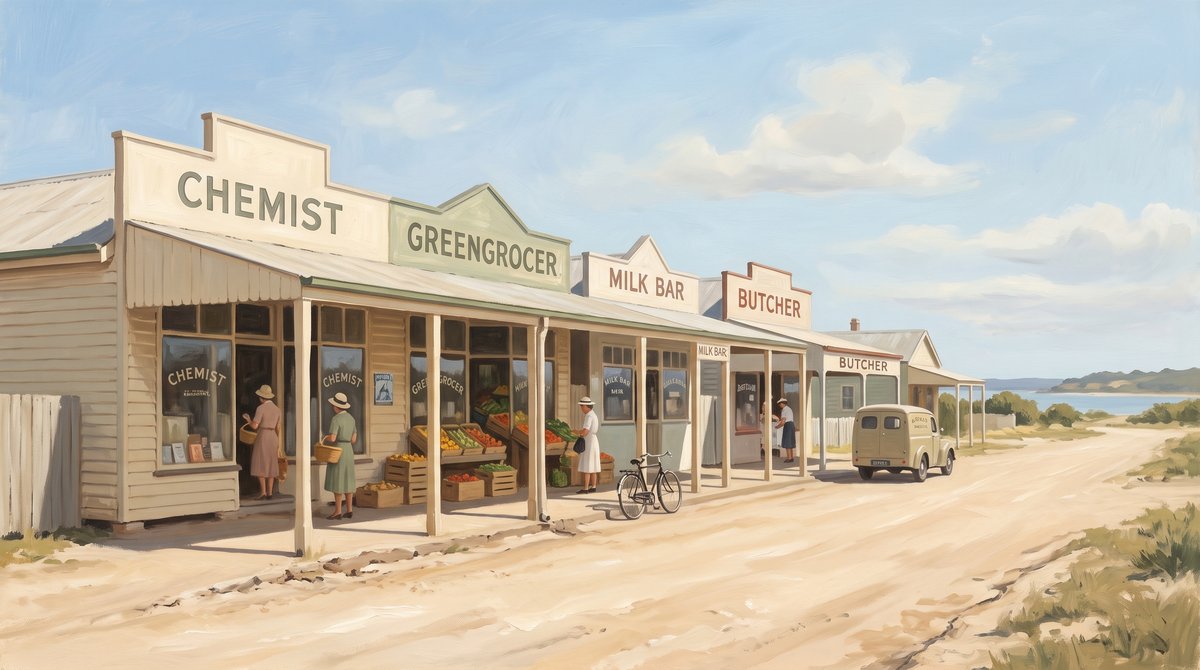
Cavill Avenue: a chemist, a greengrocer, a milk bar, a butcher, and that is the commercial life of the town. Renamed in 1945, so this is its first full year under the name — and a good many locals are still saying Elston.
The time
1946 to 1956 — eleven years, opening in post-war austerity and closing as the strip visibly arrives.
The men are coming home. Materials and labour are rationed, with residential need outranking holiday construction, so the place is full of things that cannot be repaired because the parts cannot be got. Surveyors are coming down from Brisbane. Holidaymakers arrive from Brisbane and Melbourne on Friday and leave on Monday, and the town's population halves and doubles every week.
The transformation is the pressure, not the backdrop. These are not books about a sleepy town with a modern epilogue. Farms, dirt roads and quirky pubs become a high-rise city inside a working lifetime, and development on this coast was unusually unrestricted by Australian standards. The World's position on that is deliberate and worth stating plainly: change is the subject, not the threat. Development is not the villain by default, the people arriving to answer the question are not automatically wrong, and these are not a lament for what was lost. The interest is in who decides, who profits, who is not asked, and what it costs them.
Two dates that quietly end things. The first motel, the El Dorado, opens at Surfers Paradise in 1954; "no motels yet" is true in book 1 and false by book 20. The skyline stays low until Lennon's Broadbeach goes up five storeys in December 1956. A fact true at the start of this span and false at the end is not a detail — it is the World working as designed.
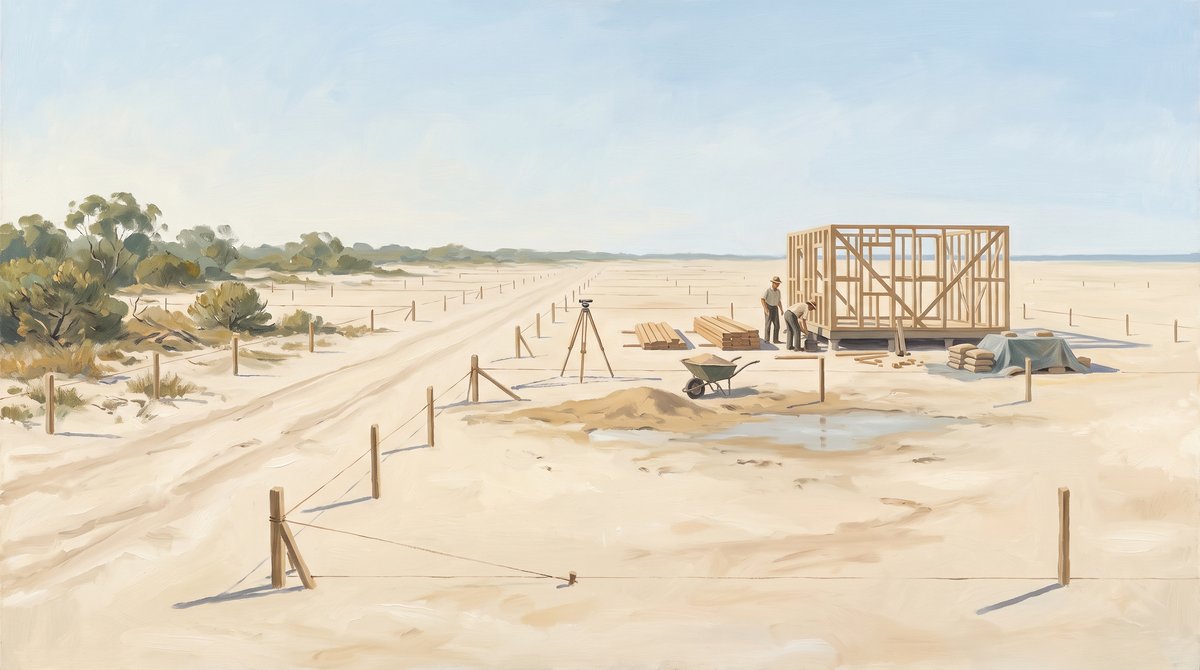
Survey pegs, string lines, a wheelbarrow of sand fill, and one frame going up with nothing either side. Allotments at about six hundred pounds. This is the boom arriving before the buildings do, and it is the pressure the whole World runs on.
Daily life
One building does most of the town's social work, and it is the reason the town has its name.
The Surfers Paradise Hotel. Jim Cavill opened the original in 1925 — sixteen bedrooms, timber, on the corner of South Coast Road and Ferry Road, between the ferry jetty and the beach. It burnt to the ground in July 1936 — the zoo's lions got out. The replacement opened on 24 September 1937: two storeys of red brick and white stucco under golden yellow tiles, with an unusual circular tower carrying a two-level honeymoon suite, French doors, parquetry of walnut, rosewood, red bean and blackwood, and art deco lead-lighting. Forty-one rooms, thirty of them bedrooms upstairs, telephones in every one, some with private bathrooms and balconies. A Johnny Walker sign stood on the tower for years. Downstairs, a public bar, a lounge bar, a private bar, two large rooms serving as cabaret and ballroom, a dining room, the kitchen and a palm court. Log cabins in the yard, which were Cavill's own idea and reportedly an Australian first.
But nobody in these books walks into the hotel of 1937. They walk into a nine-year-old building that has just had an army through it. The South Coast was a major rest-and-recreation destination for Allied troops, and thousands of American, New Zealand and English servicemen and women spent leave here — then went home and told people, which is precisely what causes the post-war tourism surge these books open on. So: worn treads, chipped paint, mismatched replacements, chromium gone dull, things broken that cannot be re-ordered because everything is rationed. Busy and shabby are the same condition in 1946. The staff remember the war years, and some guests are returning servicemen bringing a wife back to the place they had leave.
Behind the hotel, the zoo — Cavill's own, reckoned one of the best private zoos in Australia, in landscaped gardens: kangaroos, wombats, exotic birds, and also leopards, lions, apes and bears. Large predators, in the middle of a small town, as an ordinary Tuesday. And Topsy the Talking Horse, popular right through the forties and fifties, trained by Tom Dennison, answering by nodding and shaking her head and tapping out numbers with a hoof.
The Cavill family hold the hotel through every year of this World. Jim Cavill dies on 5 March 1952, reportedly in a room of his own hotel; the family keeps the place until September 1957, after the books close. It is going strong throughout. It is never written fading.
Away from the hotel: fishing and boating on the backwaters, the dance floor on a Saturday night, the bean rows and the small farms behind, and the weekly emptying and refilling of a town where a great many people are only ever passing through.
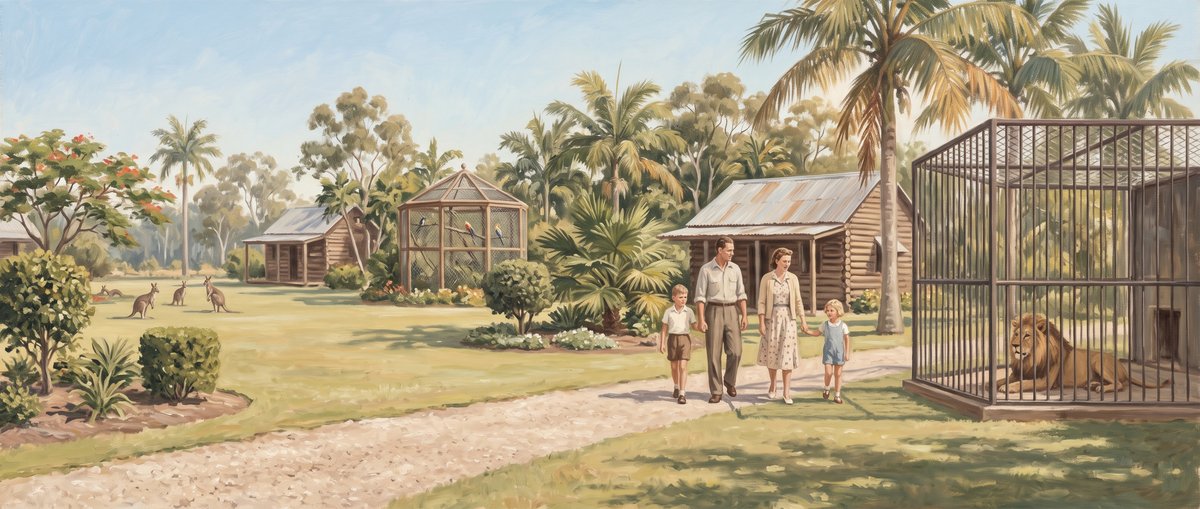
Cavill's own zoo, in the gardens behind the hotel: kangaroos on the lawn, birds in the aviary, log cabins to let, and a lion in a cage beside the path. Reckoned one of the best private zoos in the country. The oddness of it is not a joke — in 1936 the lions got out and the original hotel burnt down.
The rules
The name is the whole thing, and it works in two directions.
The town was renamed after the pub, not the other way round. Cavill opened his hotel in a town called Elston and named it the Surfers Paradise Hotel, then lobbied for years to have the town renamed to match his pub. The council agreed on 1 December 1933, on the grounds that "Surfers Paradise" was more marketable. There was never an Elston Hotel.
In 1946 a great many locals still say Elston. Which name a character uses is characterisation — old settlement against new money, resident against visitor, often simply age. And the holdouts are not being quaint: they are declining to call the place by a publican's advertising.
⚠ Nobody says "Gold Coast." The district in period is the South Coast, so named for being south of Brisbane. The phrase begins life as an insult — coined off the inflated prices charged in the post-war boom, and initially considered derogatory by the locals it was aimed at. Every source puts it current from about 1950; none places it in 1946. The South Coast Town Council is not renamed until 23 October 1958, seventeen years after the other renaming, and the two must never be conflated. No character, narrator, sign or letterhead uses it.
So the brand is a word that never appears in the books. The covers say Gold Coast; the prose never does. Recognition from the name, surprise from the date. That is the hook working as intended, not a contradiction to be tidied up.
What these books will and will not do. Murder is permitted and is often the premise, but it is always off-page, discovered rather than depicted, never graphic. The detective is always a civilian; the police are sometimes helpful and sometimes obstructive and never the solution. Romance is warm and closed-door. No gore. Firearms exist — a service revolver in a demobbed man's drawer, a .22 behind a farm kitchen door — and they carry menace, but the murder method is never a gunshot and no firearm is discharged on the page. Stakes stay personal and communal.
And six of the twenty-four books have no body in them at all. So do all of the Elston stories. Never promise a corpse this world has not got.
The map
Read it north to south, and narrow.
- The Broadwater and Southport — the sheltered water at the top, and the older, more established town that already has the offices, the court and the council.
- South Stradbroke — across the Broadwater, an island only since 1898.
- Surfers Paradise / Elston — the strip: hotel, Cavill Avenue, the beach, the log cabins and the zoo. Whatever it is called this week.
- The Nerang River and its backwaters — running behind the strip, west of everything. Mangroves, tidal creeks, moorings, and a houseboat.
- Goat Island — a natural landform in the river. It is not Chevron Island and will not be for years.
- The subdivided blocks and sand tracks — south and west, pegged out ahead of the houses.
- The farms and the flats — bean country running down toward the low ground.
- Brisbane — forty-five miles north, where the surveyors, the money and the newspapers come from.
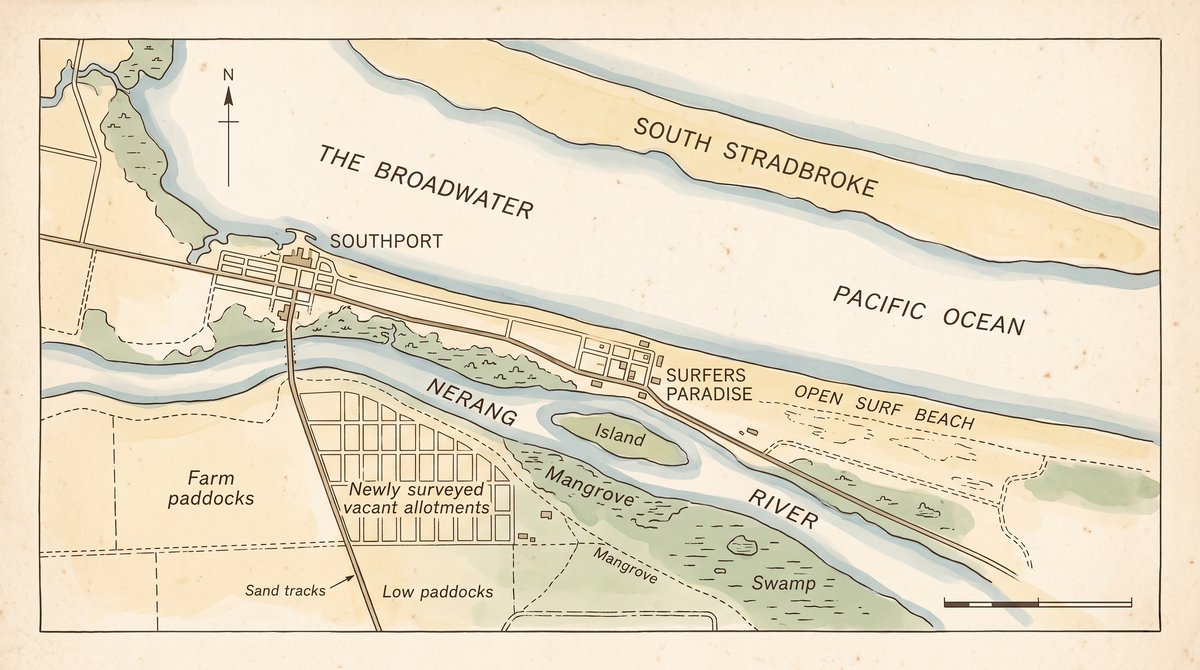
Read it north to south, and narrow. The Broadwater and Southport at the top, the strip down the right between the surf and the river, and the Nerang winding behind everything through mangrove and swamp. The ruled empty rectangles marked newly surveyed vacant allotments are where the rest of it goes.
Who you keep meeting
Ottilie "Tilly" Sommerfeld carries all twenty-four books. Born at sea in 1921, her birth never registered on the Australian side, which is a quiet and permanent problem for a person in a world that runs on paper. She lives aboard her late father's houseboat on the river and works as tea lady at the police station — which is the whole trick of her: she is inside the room where things are said, and nobody counts her as being in it.
Her surname was never anglicised. Many German-descent families in the district anglicised theirs during the wars; hers refused. That refusal is the same refusal as the Elston holdouts', and the World's theme therefore sits inside its protagonist's name. No character ever remarks on it.
The naming register of the district is Southeast Queensland and deliberately not the Irish-Catholic Sydney register: German-descent Logan and Darling Downs farming families, English and Scottish grazier stock, and cane-country Italian.
Around her, the town supplies its people by function rather than by cast list — the hotel's housekeeping and desk and kitchen and bars, the seasonal guest register, the zoo and the gardens, the shopkeepers of Cavill Avenue, the surveyors and land agents down from Brisbane, the returned men, the farming families out on the flats, and the weekenders who are gone by Monday.
Two real people stand in load-bearing positions: Jim Cavill and Tom Dennison. They may be difficult, obstructive, secretive or wrong. Casting a real named person as a murderer is a separate decision that must be ruled explicitly, book by book, and never arrived at mid-plan.
What this world promises
### What is a place worth before anyone has decided what it's for?
Warm, witty, character-driven mysteries with heavy period texture and community loyalty as the emotional spine, resolving restoratively. The particular flavour, against a settled-community cozy, is impermanence — a place half-built, half-sold, and half-emptied every Monday.
The recurring subjects:
- A place being priced before it is understood — the land boom as a moral question, not a motive well.
- Naming as power — Elston against Surfers Paradise, and the Gold Coast sneer coming up the road.
- What the returned owe and are owed — demobilisation, rationing, austerity, a country still counting.
- Belonging in a town that empties every Monday — who counts as a local when everyone is passing through.
- Ordinary people defending something unfinished from people who have worked out how to price it.
- Community memory against the incomer's ledger — what a place knows against what it is worth on paper.
Every arc answers the question from a different vantage, and the chronological spine is that question being answered badly, in public, over ten years.
This world is sealed from Bondi. No shared characters, no cameos, no crossover. The byline and the shelf are shared because they are the same readers; the separation is internal architecture only, and nothing reader-facing suggests one world.
Where to start
The Tilly Sommerfeld Mysteries — one continuous reading order of twenty-four books, shelved as six four-book arcs. Start at book 1, A Death in Probate.
Elston Origins — short stories set roughly ten years earlier, one for each of the people the novels lean on, told in their own voices, on a coast still arguing about its own name. Nobody dies in any of them. Start with The Standing Account. Three of six are written.