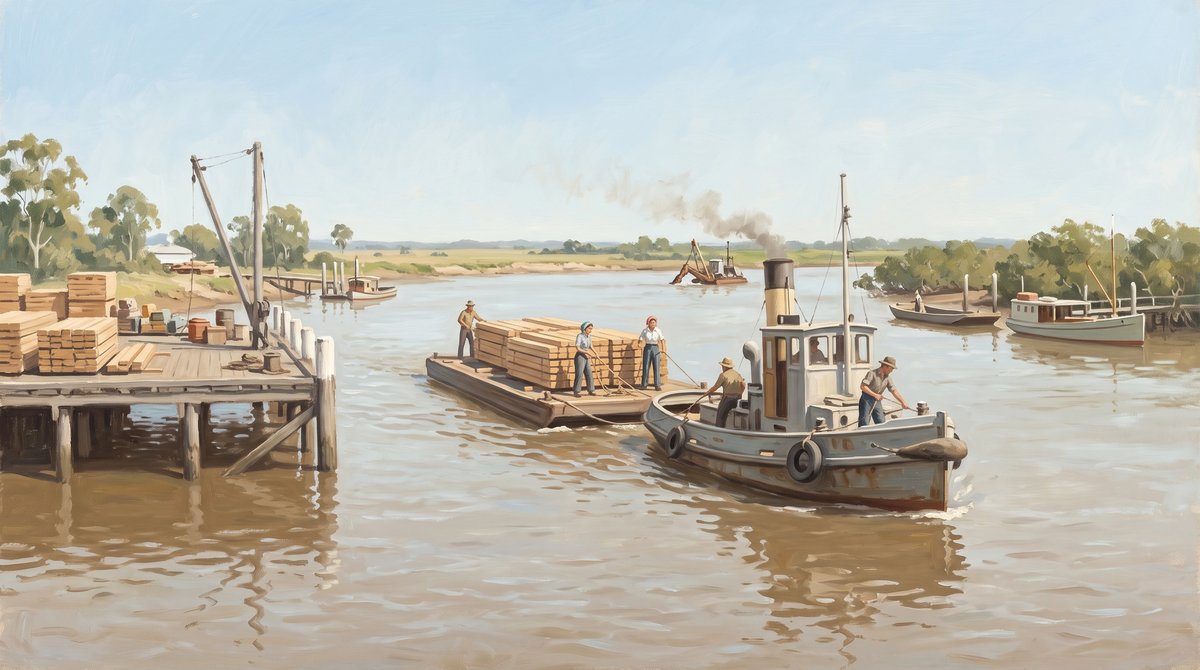
Working water. In these years the Nerang carries small diesel tugs, flat-deck timber barges, punts and dredges out of Southport and the reaches above it, and nobody on it is there for the view. This is the district ten years before the boom finds it, which is the whole reason these six stories are told.
Inheritance header
Set in the world of The World of the Gold Coast, ten years earlier — the same strip of Queensland sand, before the war and before the boom, when the argument about the district's name was still just an argument. Here is what's ours.
The patch
Six people, six origins, all of them before the World starts.
The Tilly Sommerfeld novels run 1946 to 1956 and are narrated by one woman who is in every scene of all twenty-four books. This line is the other half — the people she will need, before she needs them, each telling the one story about themselves that the novels never get to tell.
Six standalone cozy cases running from 1935 to December 1945, each narrated in first person past by its own subject. Nothing binds them but the district, and not one of the six knows the others matter.
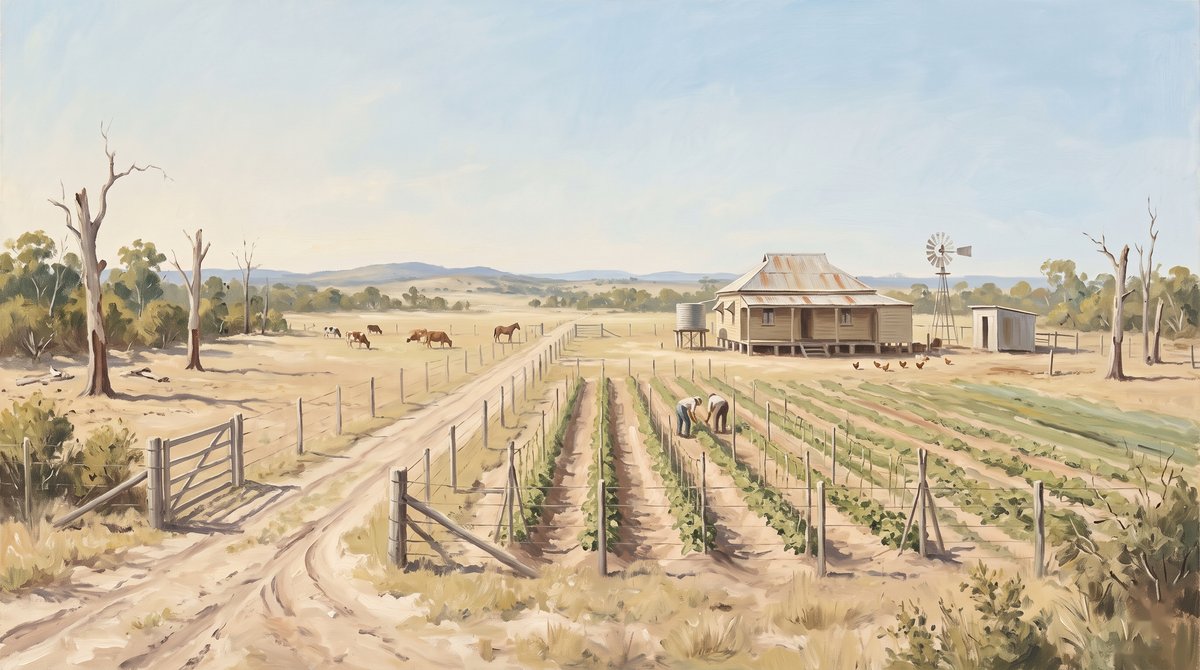
A selection west of the strip, being farmed rather than subdivided. No survey pegs, no barrowed sand, no allotments: in these years the boom has not arrived, and that is the whole reason this line is set here.
The set
- The Surfers Paradise Hotel — the current building dates from 1937, so across most of this line it is new, not the worn house the novels open in. From 1942 it carries wartime leave traffic: busy, and rationed.
- The Southport School of Arts — a subscription reading room with minute books and borrowing registers, sharing its roof with the RSL as a Memorial Hall. There is no lending library in this district at all until 1958.
- The Nerang River and the Broadwater — working water in these years: small diesel tugs, flat-deck timber barges, punts, dredges and cargo launches out of Southport, Main Beach, Budds Beach and the Nerang reaches.
- The selections west of the strip — small farms being farmed, not yet being subdivided. In this line's years the boom has not arrived.
- The police station — a district station, unhurried, where a sergeant sits down to think.
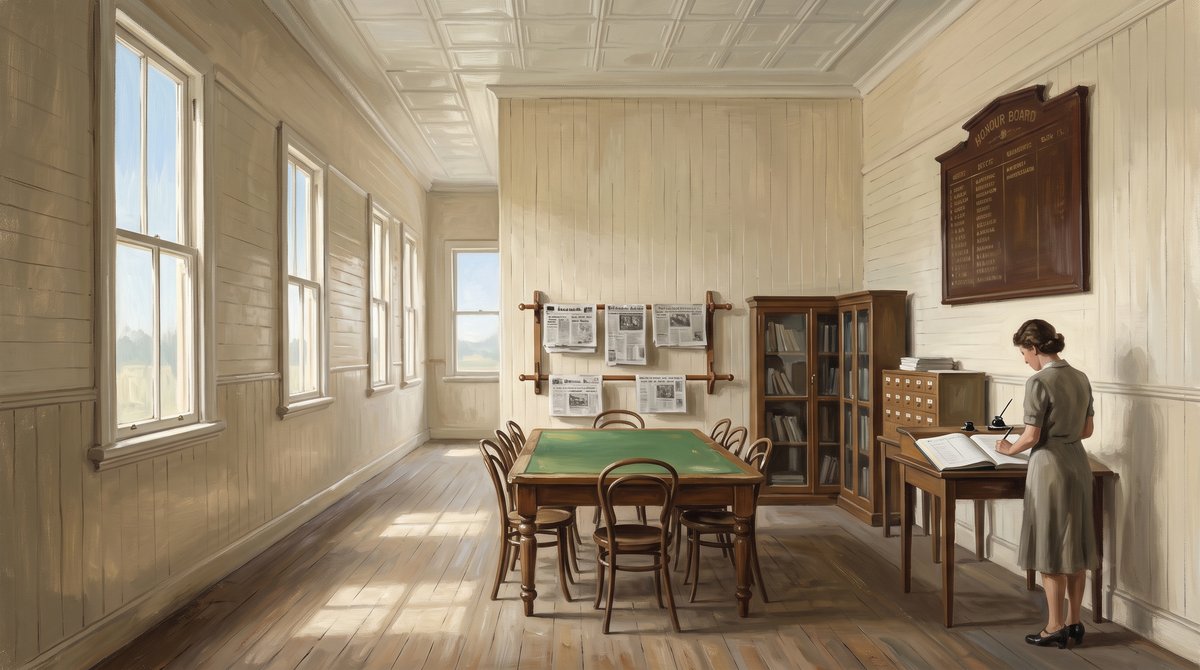
A timber hall in Nerang Street: a subscription reading room, sharing its roof with the RSL. Three bodies with a claim on one room, and no public lending library anywhere on this coast until 1958.
The cast
Six narrators, one each. Every entry is first person past in its own subject's voice, and the voices are deliberately unlike each other.
Two of them walk straight into the novels: Edie Larcombe becomes Tilly's closest friend across all twenty-four books, and Cec Gaunt becomes the station sergeant whose private decision is the only reason Tilly is allowed anywhere near the police station at all.
The rhythm
Six chapters each, standalone, and no arc by design. The entries do not build on one another and none requires another to make sense. The only progression is the reader's.
The case is the vehicle; the origin is the payload. Each entry hands the novels one established thing, already explained rather than asserted later — Gwen's discretion, Beryl's method-not-the-answer, Edie's jetty, the Kerswells' missing information, Dulcie's word without paper, and, in the last entry, the tolerance itself.
Read in the collected volume's chronological order they walk the district from the tail of the Depression to the month before book one.
⚠ Nobody dies in any of them. These are cozy cases, resolved on timeline, opportunity and attention, never on forensics. Warm, dry, unsentimental — the novels' register, one narrator earlier.
The question the series asks
### What is a place worth before anyone has decided what it's for?
The universe's question, asked before anyone was pricing anything. In the novels the district is being valued; here it is simply being lived in, by people who will later turn out to have been the ones who knew things. Change is the subject, not the threat — and in this line the change has not arrived yet, which is its own kind of tension when the reader knows what is coming.
Where to start
The Standing Account — entry 1, Myrtle Kerswell, 1935. Or anywhere: they are standalone by design.
Free reader magnets. The collected volume, Elston: Six Origins, is the paid product.
⚠ Four of the six are written — 1 The Standing Account, 2 The Uncut Pages, 4 The Room That Was Not Slept In, 6 The Night Cleaner. Entries 3 and 5 are planned in canon as Low Water and The Landing Marks and have no book row yet. Do not print a six-title list until six exist.
⚠ Entry 2 has prose but no packaging. No `cover_text`, no cover art, no retail kit, and it fails `data-standard --book 385` on sixteen fields. Written is not the same as shippable.